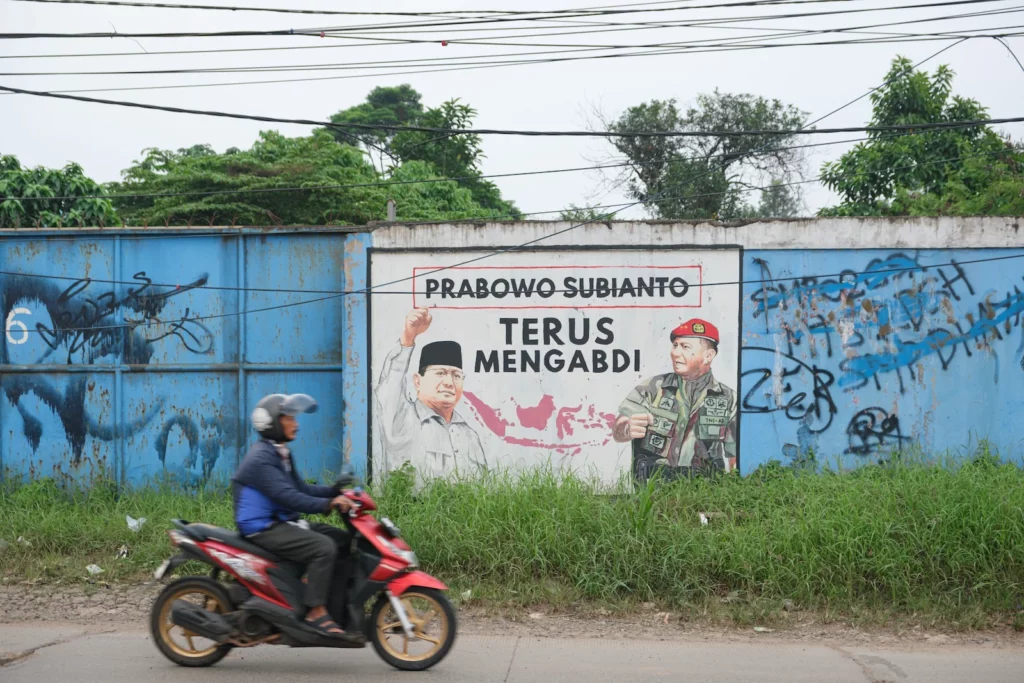
On the western fringes of the Greater Jakarta metropolitan area, Indonesian developer Sinar Mas LandWelton by Hiera is erecting Japanese-style houses on former agricultural lands. Near construction sites, a motorcyclist passes by a mural depicting Prabowo Subianto Djojohadikusumo, the Indonesian President for the 2024–2029 term. The catchphrase, ‘Terus Mengabdi’ (‘keep serving’), invokes Subianto’s shift to politicsKomisi Pemilihan Umum – Dari Militer Hingga Menjadi Presiden Indonesia 2024 sampai 2029, 2025 in 2008 after nearly three decades in the army, a period during which he was repeatedly accusedAmnesty International – Prabowo’s Dark Past Casts a Pall Over His Presidency, 2024 of involvement in human rights atrocities.
His post-military life illustrates the enduring entanglement of political power and business interests among Indonesian elites. Subianto owns stakes in an opaque web of companies that control forestry and mining concessions worth hundreds of thousandsPulitzer Center – The President's new clothes, 2024 of hectares. His allies have oil palm interests too, including his brother, Hashim Djojohadikusumo, who funded Subianto’s political campaigns using wealth derived from land and concession holdings.
Agrinas Palma Nusantara
Within an institutional system that has long prioritised the parcelling out of most of the world’s third-largestWorld Bank – Forest area, 2022 tropical rainforest to benefit industry interests, the eighthTempo – The illusion of 8 percent economic growth, 2025 Indonesian president has pushed to normalise oil palm, and deny its negative environmental impacts. Subianto rejected accusationsSekretariat Kabinet Republik Indonesia – Musyawarah Perencanaan Pembangunan Nasional, 2024 that the country’s palm oil industry, the world’s biggestUSDA Foreign Agricultural Service – Production Palm Oil, 2025, is responsible for deforestation. “Oil palms are trees, right? They have leaves, right?” he said in December 2024, before adding “They produce oxygen, absorb carbon dioxide.” Ecologically, however, razing primary forests to plant oil palms causes a substantial dropResearchGate – Biodiversity loss associated with oil palm plantations in Malaysia, 2015 in biodiversity as multi-layered habitats vanish, as well as a reductionMongabay – Oil palm does not store more carbon than forests, 2007 of the area’s ability to sequester Earth-warming carbon dioxide (CO₂), contributing to accelerating global climate change.
The military-backed campaign launched in 2025 by Subianto to millions of hectaresIndonesian National Police – AGO to seize 4–5 million hectares of illegal palm oil plantation land, 2026 of oil palm plantations allegedly operated illegally in forest areas has done little to return the lands to their pre-plantation ecological state. Instead, about half of the land seized in 2025 was transferred to Agrinas Palma Nusantara, a newly launched state-owned enterprise that will continue to cultivate the lands as plantations to become the world’s largestReuters – Thousands protest against state takeover of palm oil plantations in Indonesia's Riau, 2025 palm oil company.
Semantic shift
The final normalisation step took place in January 2026 when the official dictionary, Kamus Besar Bahasa Indonesia (KBBI), updated its definitionTempo – When oil palms become trees, 2026 of oil palm from a plant (tumbuhan) to a tree (pohon). A few days later, Subianto stood before thousands of government officials and calledTempo – Prabowo defends palm oil expansion, 2026 oil palm a “miracle crop”. The KBBI change could pave the way for Indonesia to no longer label the chopping down of primary forests to plant oil palms as deforestation. In fact, the monoculture crop was responsible for a third of deforestationPLOS – Slowing deforestation in Indonesia follows declining oil palm expansion and lower oil prices, 2022 in Indonesia over the first two decades of the 21st century. Like urban expansion in the Greater Jakarta metropolitan area, agribusiness expansion is another expression of a nationwide land-conversion process.