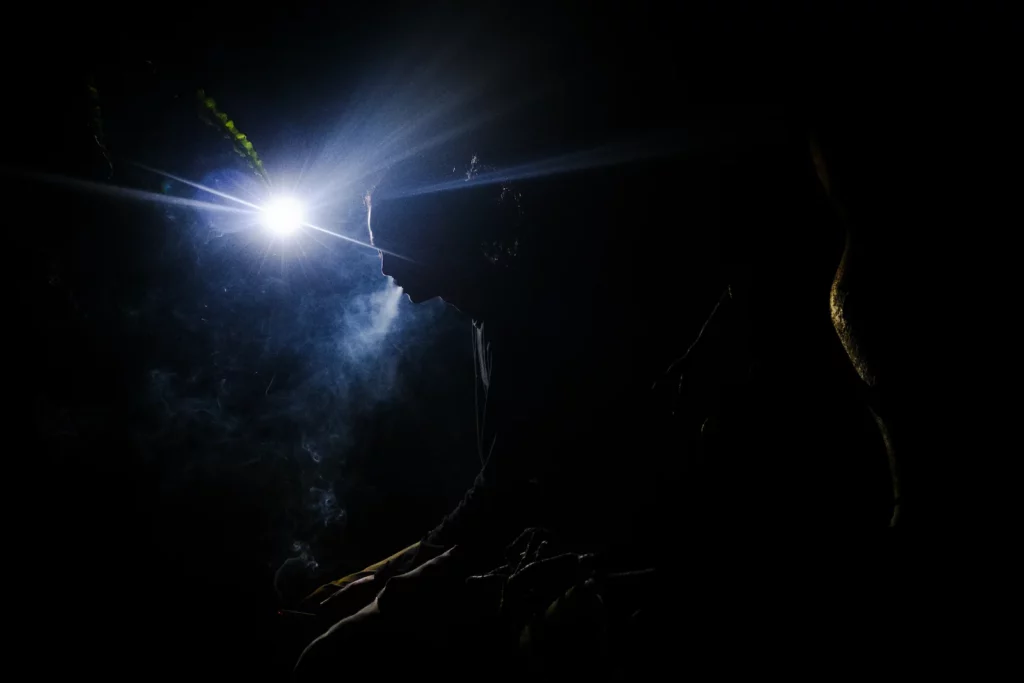
Enveloped in a tobacco haze, a man smokes a cigarette at night, seated on the trunk of a tree in a forested area of the province of East Kalimantan on Borneo island. In the early 2020s, roughly 69 millionWorld Health Organization – Global Adult Tobacco Survey, 2021 Indonesians – one third of the adult population – smoked cigarettes. Consumption is predominantly male, with more than thirty times as many men smoking as women, and the average Indonesian smoker burns 13 cigarettes per day.
Public discourse has largely framed the smoking habit as a health issue. The World Health Organisation described tobaccoWorld Health Organization – Tobacco Key facts, 2025 as “one of the biggest public health threats the world has ever faced”, saying it kills more than 7 million people each year globally. Smoking significantly reduces life expectancy, and tobacco-related illnesses heavily burden public health budgets. The risk of serious illnesses, acknowledged by eight in ten Indonesian smokers, has not translated into a sustained decline in consumption, with just 8% of them expressing thoughts about quitting in the upcoming year.
Intensive use of agrochemicals
Alongside its health impacts, cigarette consumption generates a large waste stream. Indonesians smoke an estimated 300 billion cigarettes annually, and the resulting discarded butts weigh as much as about a hundred Airbus A380Tobacco Atlas – Country Factsheets, 2025Airbus – A380 Facts & Figures, 2022 fully loaded with passengers, luggage and kerosene. It is estimated that up to two-thirdsNational Geographic – Cigarette butts are toxic plastic pollution, 2019 of cigarette butts – composed primarily of plastic fibres – humans throw away enter the natural environment where they fragment into microplastics. They also contain over 7,000ScienceDirect – Potentially toxic elements leachates from cigarette butts into different types of water, 2021 toxic chemicals, which are lethalTobacco Control – Toxicity of cigarette butts, and their chemical components, 2011 to marine and freshwater life.
And the environmental footprint of cigarettes extends upstream beyond their disposal, with cultivation exerting pressure on Indonesian tropical forest ecosystems. The country is the fourth-largestWorld Health Organization – World No Tobacco Day, 2023 tobacco producer in the world, with cultivation largely concentratedBadan Pusat Statistik – Produksi Perkebunan Menurut Jenis Tanaman Menurut Provinsi, 2020 in Central and East Java. The crop is associated with intensive use of agrochemicals derived from the fossil fuels industry, which 98%World Bank – The Economics of Tobacco Farming in Indonesia, 2020 of tobacco farmers reported to use. The agricultural activity has been linked to deforestation, while matches used for ignition of cigarettes anchor additional demand for wood products, further contributing to the ecological cost of smoking.