
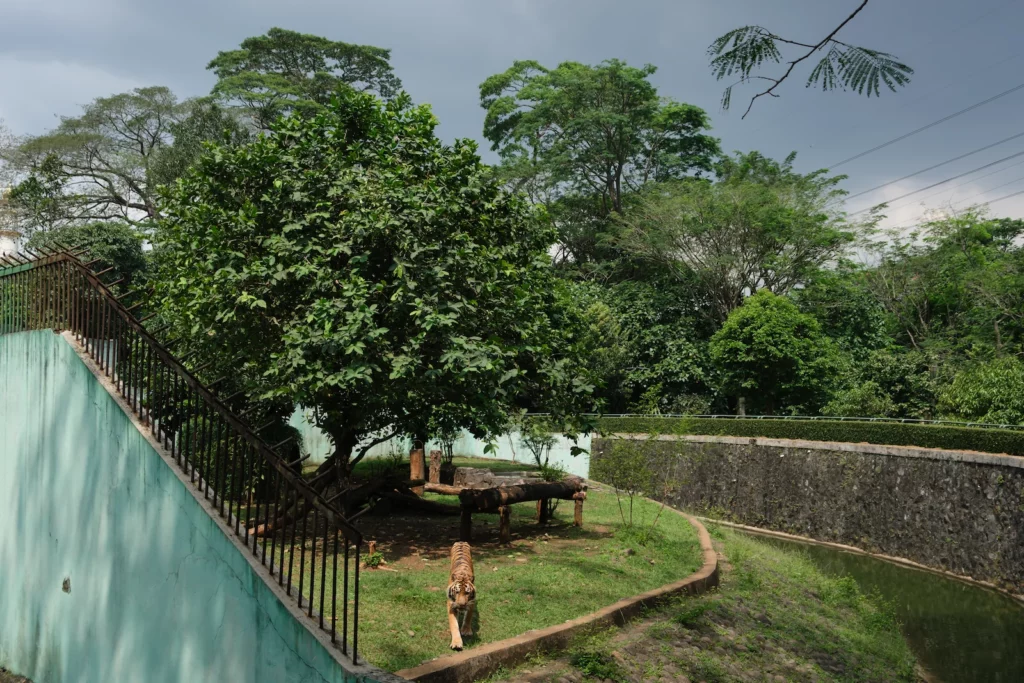
A tiger walks across a grass-planted enclosure surrounded by concrete walls and fencing at the Ragunan Zoo in Jakarta. First established in 1864Antara – Ragunan Zoo emerges as popular place to visit, 2018 during the Dutch colonial era under the name Planten en Dierentuin, the zoological park was home to over 4,000 animals as of 2018. It has been a longstanding site of public engagement with biodiversity for generations of Indonesians. At the national level, nearly five dozenJakarta Globe – Indonesian Zoos Start Fundraising to Feed Animals During Pandemic, 2020 zoos have played a role in recent decades in exposing visitors to some of the more than 300,000 wildlife speciesUnited Nations – Country results report 2021, 2022 that have inhabited the Southeast Asian country long before it gained its independence in proclaimed independenceTempo – Dutch PM Recognizes Indonesia's 1945 Independence Date, 2023.
The Ragunan Zoo also sits within a history of animal captivity and display that dates back millennia, as the first zoo was established in the ancient Egyptian city of Hierakonpolis 3500 yearsGuinness World Records – First zoo BCE. The practice has often prioritised human entertainment and monetisation of wildlife over conservation efforts. Beyond captive settings, Indonesian tigers have largely disappeared from the wild as expanding human activity severely reduced their natural habitat in recent centuries, despite calls from zoological parks to protect the felines.
The systematic decimation of tiger populations started during the colonial era when Dutch East Indies authorities classified tigersNational Archives of Indonesia – Inventaris Arsip, Departement van Binnenlandsch Bestuur, Serie Toegangen 1849-1950 as pests to be eradicated to facilitate the expansion of plantation agriculture. Dutch colonists then relentlessly hunted Bali tigers – the smallest tiger subspecies ever recorded – and the last specimen was shot dead in 1937Guinness World Records – Smallest tiger subspecies ever. The Javan tiger, also targeted by Dutch hunters, including for pastime activities, was officially declared extinct in 2008Mongabay – ‘The Javan tiger still exists’, 2024. Recent research suggests the species might still exist. Indonesia’s last known tiger, the Sumatran tiger, is critically endangered with an estimated 568 adult individualsIUCN Red List – Tiger (Panthera tigris), 2024 remaining. The last specimens are squeezed into smaller areas, and forced into human-tiger conflicts.
‘Low-risk, high-reward’
The transition from the colonial era to the modern state of Indonesia has been marked by a state-led assault on the world’s third largestWorld Bank – Forest area, 2022 tropical rainforest, where tiger populations live. The area of primary forest in the country dwindled by more than two-thirdsRoughly 145 million hectares in 1950: WRI Indonesia – The state of the forestAbout 48 million hectares in 2020: PNAS – Land in limbo: Nearly one third of Indonesia’s cleared old-growth forests left idle between 1950 and 2020 as successive government officials pushed to cash in short-term profits. Vast parts of Indonesia’s forest areas have been gradually parcelled out to oil palm, coffee, timber and mineral interests tied to global markets.
In parallel with habitat loss, tiger populations are also targeted by poaching and trafficking, including for the sale of their skin, bones and teeth. Indonesia ranks as the world’s third largestWorld Wide Fund for Nature – Skin and bones, 2022 supplier of tiger parts, where the illegal activity is often considered ‘low-risk, high-reward’. Just a quarter of individuals arrested in Indonesia in relation to tiger trafficking between 2000 and 2022 were jailed. Taken together, the global tiger population, which dropped from 100,000 at the start of the 20th century to around 4,500 individuals today, has disappeared from 94% of its historical range.