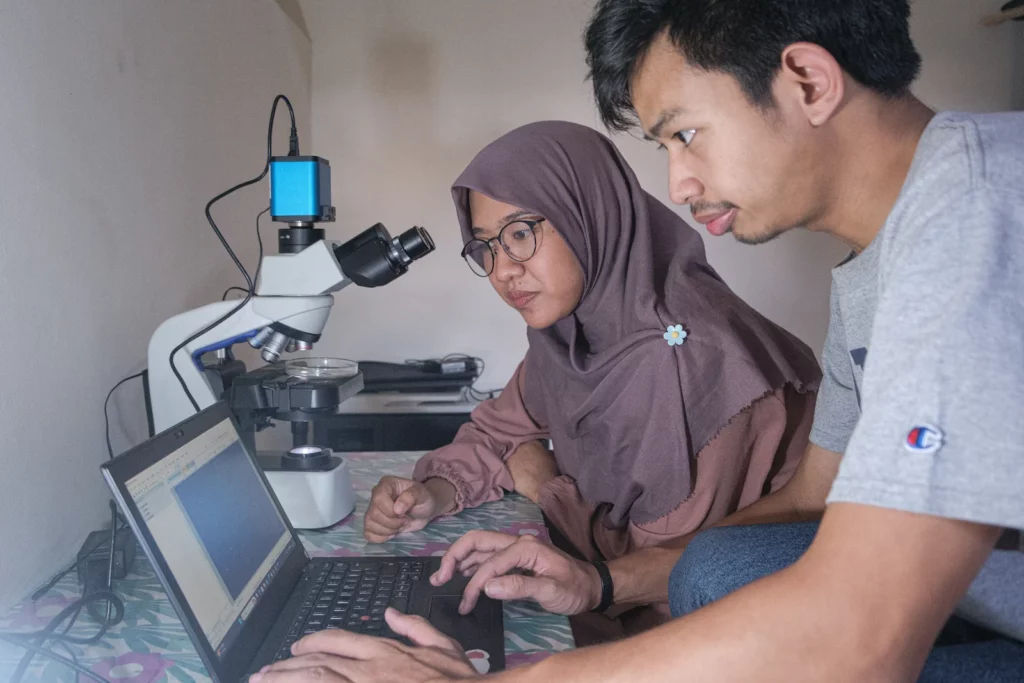
In the basement of her home, natural sciences and biology lecturer Noverita Dian Takarina has installed laboratory equipment used by students to conduct research and exchange ideas. On this day, the residential facility hosts a group of students from Universitas Indonesia (UI), the oldest public higher education institution in Indonesia, originally established in the mid-19th centuryUniversitas Indonesia – Master of Management. Rahmadyfa Maulida Azzahrah (center) and Nathan Josafat Soelias (right) use Takarina’s microscope as they analyse the presence of microplastics in marine ecosystems.
The research they conduct, along with a few other students, helps expand the body of academic knowledge on the long-term impacts of the roughly 7.8 millionWorld Bank – Stemming the Plastics Tide in Indonesia, 2022 tonnes of plastic waste Indonesia generated annually in the early 2020s. Indonesia is not alone; the issue spans the wider region. Across Southeast Asia, more than halfOECD – Regional Plastics Outlook for Southeast and East Asia, 2025 of plastic waste is not recycled, incinerated, or kept in sealed landfills.
Fouling the Indian Ocean
A share of this volume of plastic waste finds its way to the ocean, with up to 1.3 millionDuke University's Nicholas Institute – Plastic Pollution Policy Country Profile, 2022 tonnes annually in the case of Indonesia. Unlike organic matter that biodegrades once in the aquatic environment, plastics disintegrate into microplastics due to solar radiationNational Oceanic and Atmospheric Administration – Marine Debris Program, 2023 and constant wave movement. These tiny plastic particles have been shown to impair the growth of phytoplankton, the base of the aquatic food web.
The effects of Southeast Asia’s waste leakage are felt far beyond the region’s borders. From Indonesian shores, some plastic waste drifts to the Indian Ocean via the Indonesian ThroughflowWoods Hole Oceanographic Institution – Indonesian Throughflow, a strong current that moves from the Pacific to the Indian Ocean. About a tenthBadan Riset dan Inovasi Nasional – BRIN reveals Indonesian plastic waste can reach Africa in less than a year, 2024 of the waste washes up along the southwestern coast of the Indian Ocean within less than a year, according to Indonesian oceanographic researchers.
Azzahrah and Soelias’ research draws attention to the unaccounted costs of plastic use. Terrestrial and marine ecosystems have been treated as the dumping ground of the fossil fuel industry since large-scale production of plastics started in the 1950s. In the following seven decades, humans have produced roughly 10 billionOur World in Data – FAQs on plastics, 2018 tonnes of plastic, equivalent to the weight of about 18,000 Burj KhalifaLego Architecture – Burj Khalifa, the world’s tallest structure. Far from the public eye, the Great Pacific Garbage Patch, first discovered in 1997National Geographic – Great Pacific Garbage Patch, 2025, has become the world’s largest accumulation of ocean microplastics, most of which originate from North American and East Asian countries.