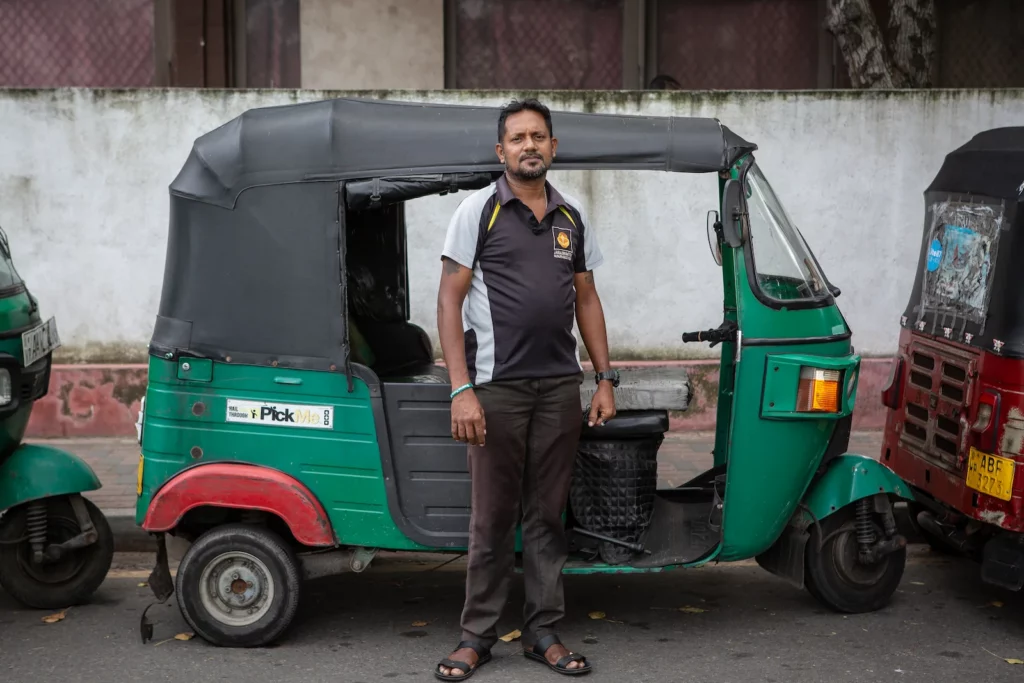
Samith Da Santa Perreira, 43, used to earn roughly 3,000 Sri Lankan rupees per day ($8) transporting passengers around Colombo in his tuk-tuk. His parents, his wife and their two children relied on his daily earnings. That routine ended when Sri Lanka failed to import the fuel that powered his motorized three-wheeled vehicle. In June 2022, when he arrived at his usual fuel station in Colombo, Perreira was asked to line up and wait, engine off, alongside other tuk-tuk drivers asleep in their vehicles. “I did not move an inch. Maybe tomorrow they will have fuel, who knows,” he said after a 15-hour wait.
Perreira’s halted livelihood stemmed from a crisis that hit the South Asian country that year and rapidly depleted foreign exchange reserves, leaving Colombo unable to shoulder the cost of oil imports. Perreira’s tuk-tuk was one vehicle among a fleet of 8.4 millionDepartment of Motor Traffic – Performance report, 2022 that formed the backbone of mobility in Sri Lanka. Yet the transport sector accounted for more than 80%International Energy Agency – Sri Lanka, 2023 of Sri Lanka’s consumption of oil products, thereby locking the nation into dependence on a handful of foreign oil producersWorld Integrated Trade Solution – Sri Lanka Petroleum oils, 2023. As fuel stations shut down, the vulnerability created by high dependence on imported fossil fuels surfaced within weeks in everyday life.
Electrify 500,000 tuk-tuks
Standing next to his tuk-tuk, Perreira voiced frustration. “Sri Lanka is a very good country, but how it is managed is a failure,” he said. The crisis found its origin in macroeconomic vulnerabilitiesAsian Development Bank – Sri Lanka, 2023 and unsustainable budget deficits that predate the early 2020s, as well as economic contraction resulting from policy missteps by the government of then Sri Lankan PresidentPresidential Secretariat – Former Presidents Gotabaya Rajapaksa. The politician is one of the members of a political dynasty that began its ascent with the appointment of Mahinda Rajapaksa as prime ministerPrime Minister’s Office – Former Prime Ministers in 2004. The family’s tight grip on the island nation culminated in 2020, when Gotabaya Rajapaksa appointed five relativesReuters – Sri Lanka's Rajapaksa family cements power with ministerial picks, 2020 to cabinet and ministerial posts.
A month later, Gotabaya Rajapaksa fled the country to escape the crisis. The political transition that ensued was marked by enthusiasm. The Ministry of Transport and the Ministry of Energy launched a project with the United Nations Development Programme to electrify 500,000 tuk-tuksUnited Nations Development Programme – Electric Mobility and Low-Carbon Solutions for Sri Lanka, 2023 over five years, of which only 140United Nations Development Programme Sri Lanka, 2025 have been electrified midway through the program period.
The slow progress contrasts with the persistent dependence on imported fossil fuels to power mobility. In its 2024 progress reportMinistry of Energy – Progress Report, 2024, the Sri Lankan Ministry of Energy acknowledged that the country remains “totally dependent on imported petroleum products”. For drivers like Perreira, mobility still begins at the pump, where the energy system that once brought his tuk-tuk to a standstill remains largely unchanged.