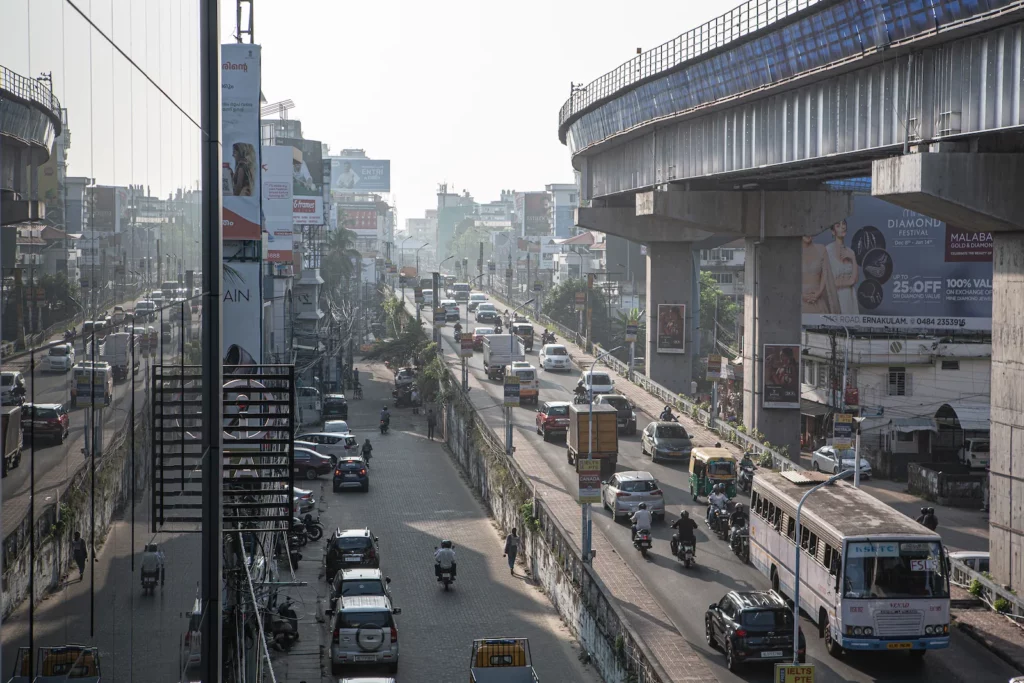
As the sun sets over the South Indian city of Kochi on a January 2024 weekday, its arterial roads fill with evening commuters traveling in buses, motorbikes, motorized three-wheeled vehicles and cars. The daily traffic jam is mirrored in the glass facade of a nearby building. Land transport did not historically serve as the main form of mobility in Kochi, a city fragmented by several backwaters, river channels and the Indian Ocean. For centuries, waterborne transport was the primary means of commuting between various parts of the city, until the construction of a network of bridges and road infrastructure triggered the shift.
Across India, road-based mobility has expanded sharply in recent decades. From 300,000 registered vehicles at the beginning of the 1950s, the country’s fleet increased to roughly 50 millionMinistry of Road Transport & Highways – Road Transport Year Book, 2019-2020 by the start of the 21st century, and more than 350 millionMinistry of Road Transport & Highways – Annual Report, 2024-2025 as of 2022. The country is now home to the second largestMinistry of Road Transport & Highways – Annual Report, 2024-2025 road network in the world, equivalent to nearly 160 timesNASA – The Earth the Earth’s circumference. This rapid motorisation was not only driven by infrastructure growth, but by rising status-linked demand as private car ownership became a material marker for many households of entry into India’s expanding middle-income strata.
Breathing polluted air
The expansion of India’s vehicle fleet occurred within an energy system dominated by fossil fuels, which account for 95%International Energy Agency – India, efficiency and demand, 2023 of the energy consumed in the transport sector. In physical terms, the amount of oil burnt annually by vehicles across the country has more than tripledInternational Energy Agency – India, oil, 2023 since 2000. The shift away from fossil-fuel-powered mobility has been “slow to start”National Institution for Transforming India – Unlocking a $200 Billion Opportunity, 2025, as acknowledged by the Indian government, but adoption has begun to increase in recent years.
Yet, the fleet of 5.5 million electric-powered vehicles registered as of 2024 has raised new questions about the energy mix powering India’s grid. In fact, the country generates three-quartersInternational Energy Agency – India, electricity, 2023 of its electricity by burning coal, while coal-fired power plants emit tiny airborne particles – known as PM2.5 – with higher toxicityHarvard T.H. Chan School of Public Health – Particulate pollution from coal associated with double the risk of mortality than PM2.5 from other sources, 2023 than those from other sources.
For commuters in Kochi, the hours spent in slow-moving traffic increase their exposure to India’s ambient air, which contains on average ten timesIQAir – Air quality in India, 2025 more PM2.5 particles than the World Health Organization guideline. The pollution raises the risk of health issues such as cardiovascular problems, respiratory inflammation and cancers, and are thought to cause an additional 1.5 million deathsThe Lancet – Estimating the effect of annual PM2·5 exposure on mortality in India, 2024 in India each year.