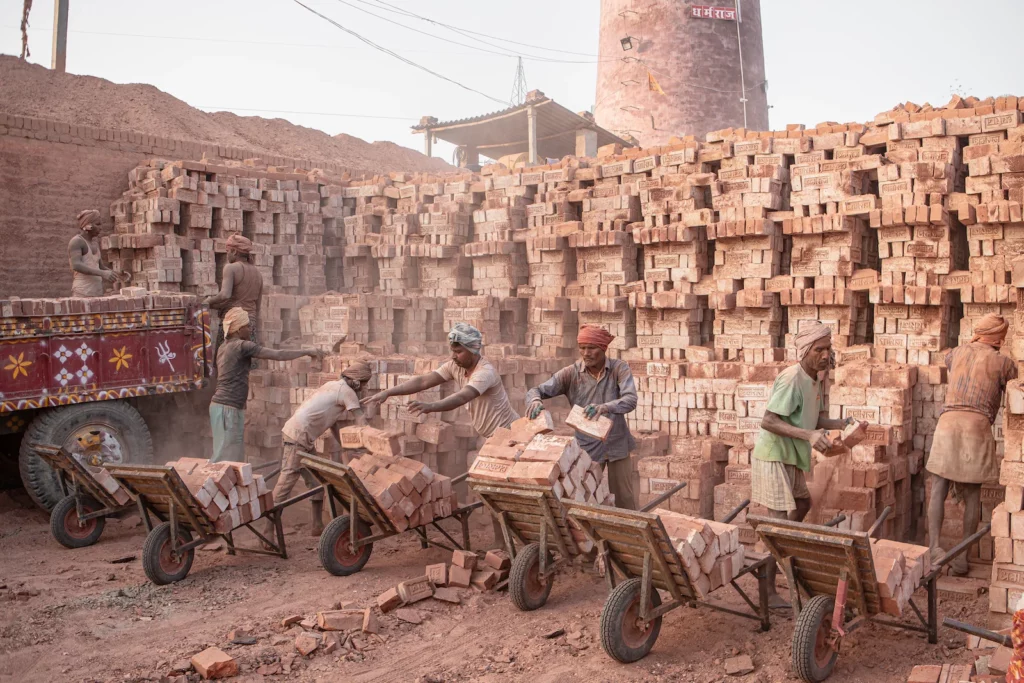
Lined up between piles of handmade bricks and a row of wheelbarrows, a group of Indian workers repeat the same motion in a steady rhythm. The silent choreography, unfolding in the eastern state of Bihar, where a thirdNational Institution for Transforming India – National Multidimensional Poverty Index, 2023 of the population lives in poverty, is a familiar sight across rural South Asia. An estimated 66,000 brick kilnsNature – Informing action for United Nations SDG target 8.7 and interdependent SDGs, 2021 operate across the Brick Belt, spanning parts of Pakistan, Nepal, India and Bangladesh.
The demand for bricks, a cheap building material widely used across the Brick Belt, has been fuelled by major demographic and urban shifts in recent decades. As India’s population more than tripledUnited Nations Data Portal – India total population by sex, 2025 since 1960, the proportion of people living in urban areas nearly doubledWorld Bank – India urban population, 2024 as cities emerged as the primary centres of economic opportunity. The rapid urbanisation led to a surge in the area covered by human-made structures, much of it brick-based construction. The urban built-up footprint of major Indian urban agglomerations doubledSquare Yards – Tracing 30 Years of Urban Expansion in Key Indian Cities, 2025 in the three decades leading to 2025.
Preying on arable lands
India is the world’s second-largestUnited Nations Development Programme – GeoAI for Brick Kilns in Bihar, 2023 producer of clay bricks, after China. However, brick kilns are not evenly distributed. They tend to cluster on agricultural lands to meet their needs in topsoil, estimated across the Brick Belt at 266 million tonnesNature – Informing action for United Nations SDG target 8.7 and interdependent SDGs, 2021 annually. Yet, this extraction carries measurable costs. Once excavated, farmlands stripped of their nutrient-rich upper layer experience a 33 to 77%Environmental Management – The Drivers and Impacts of Selling Soil for Brick Making in Bangladesh, 2018 drop in crop yield and take several years to return to their previous fertility. In response, the practice has been outlawed in parts of the region, such as in Bangladesh where it is prohibitedLegislative and Parliamentary Affairs Division – Brick Manufacturing and Kiln Establishment Act, 2013 under the Brick Manufacturing and Kiln Establishment Act of 2013. Still, the practice remains widespread as farmers sell agricultural topsoil for short-term monetary gain, or to keep their fields level with neighbouring plots already stripped of their topsoil, toward which irrigation water and agricultural inputs would otherwise run.
Beyond the degradation of agriculturally productive land, brick manufacturing is a major source of air pollution across South Asia. Brick kilns, predominantly traditional coal-fired, release Earth-warming carbon dioxide (CO2) and a cocktail of air pollutants, such as black carbon, sulfur dioxide, and nitrogen oxides, along with toxic heavy metals like mercury and arsenic. Urban demand for inexpensive building materials drives the pollution inhaled by workers loading wheelbarrows at the kiln in Bihar. The brick industry that underpins India’s urban expansion accounts for one-seventhUnited Nations Development Programme – GeoAI for Brick Kilns in Bihar, 2023 of the saturation of pollutants in the air Biharis breathe.