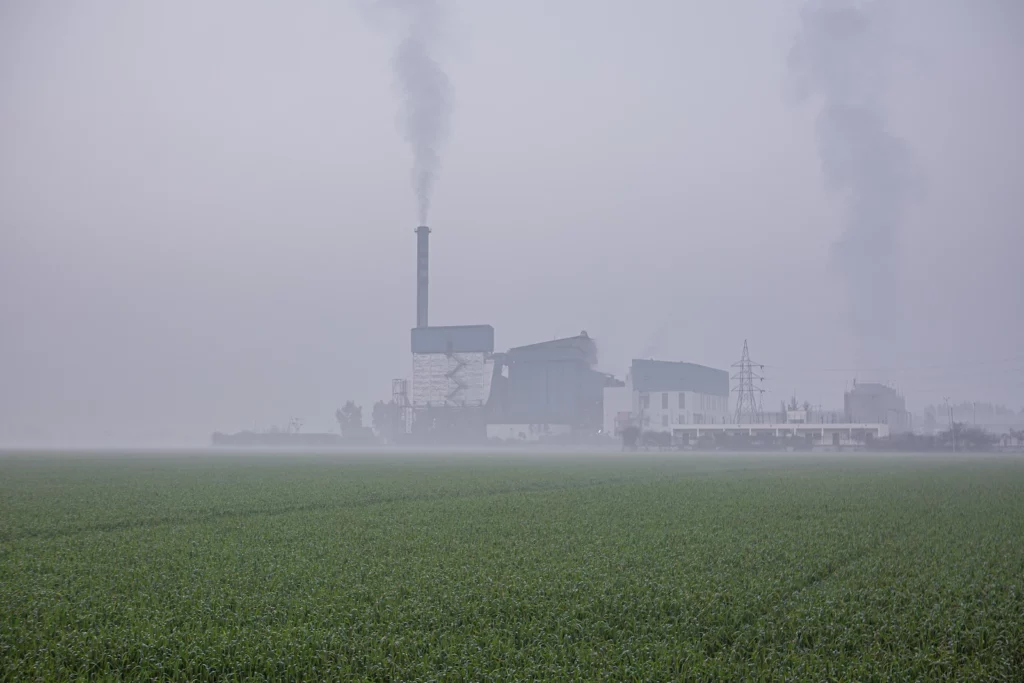
At dusk, smoke rises from a biomass power plantSAEL Industries – Faridkot Punjab burning agricultural residues to generate electricity in Punjab, a state in northwestern India. The plant is part of a network of 11 such facilities operated by Indian energy company SAEL Industries, burning about two million tonnes of residues from farming activities annually across the agricultural states of Punjab, Haryana, and Rajasthan. The supply is abundant; farm fields across India generate an estimated 500 million tonnesNational Adaptation Fund for Climate Change – Climate Resilience Building among Farmers through Crop Residue Management, 2018 of crop residues annually, 70% originating from cereal cultivation. Yet most of this resource remains unutilised. More than 80%Food and Agriculture Organization of the United Nations – Establishing residue supply chains to reduce open burning, 2018 of rice straw in Punjab is burned in the open air following harvest to avoid labour-intensive clearing of residues before the next crop cycle.
Biomass power plants only account for roughly 2%Ministry of New and Renewable Energy – Highest-Ever Renewable Energy Expansion in India’s Energy Transition Journey, 2018 of India’s installed electricity generation capacity, even as the country faces the unprecedented challenge of providing energy to the largest national population in human history, expected to reach roughly 1.7 billionUnited Nations data portal – India Total population by sex, 2025 inhabitants by 2050. Its total energy consumption already doubledInternational Energy Agency – India energy mix, 2023 in the first two decades of the 21st century, driven by population expansion and rising household living standardsNational Institution for Transforming India – National. Multidimensional Poverty Index, 2023. Electricity stands out as the fastest-growing form of energy use, as 700 millionInternational Energy Agency – India overview, 2023 Indians have gained access to electricity since 2000. Still, more than three-quarters of the energy that powers the South Asian country comes from fossil fuels, and the supply of oil and gas is heavily dependentU.S. Energy Information Administration – Country Analysis Brief India, 2025 on imports from West Asia and Russia.
Electricity’s dirty secret
To strengthen control over its energy supply, India is positioning domestically produced renewables as a pillar of its power system. The country is now home to the fourth largestMinistry of New and Renewable Energy – Highest-Ever Renewable Energy Expansion in India’s Energy Transition Journey, 2018 renewable energy fleet in the world, and plans to double it by 2030. Its solar and wind capacity reached nearly 200 gigawatts in 2026 following a seven-foldMinistry of New and Renewable Energy – Year wise Achievements, 2026 surge over a decade.
Despite the rapid addition of renewable energy capacities, India’s electricity has a dark side. Three-quartersInternational Energy Agency – India electricity, 2023 of it is generated by burning coal. The brownish-black sedimentary rock is often called the “dirtiest fossil fuel” as it is the highest emitterU.S. Energy Information Administration – Carbon Dioxide Emissions Coefficients, 2024 of Earth-warming carbon dioxide (CO2). Beyond CO2 emissions, the combustion of coal also emits sulfur dioxide,U.S. Energy Information Administration – Coal and the environment, 2024 which contributes to acid rain, mercury and other heavy metals, as well as nitrogen oxides (NOx), a gas widely recognized for its role in smog formation. The consequences are visible in air quality across the country; 36 out of the 50IQAir – World's most polluted cities, 2024 most polluted Asian cities were in India. Apart from the combustion of coal, the smog that envelops many Indian cities can partly be traced to the widespread burning of crop residues after harvest in states such as Punjab.