Off the coast of Ras Al Khaimah, at the northern tip of the United Arab Emirates, between 60 and 110 vesselsPortWatch – Port Monitor Strait of Hormuz, 2026 transit each day to and from the Strait of Hormuz. The majority are fossil fuel tankers, as the narrow waterway functions as a shipping corridor connecting West Asia’s oil and gas fields to energy-importing countries across Asia. Roughly one-fifthU.S. Energy Information Administration – World Oil Transit Chokepoints, 2026 of the world’s crude oil and liquefied natural gas cargoes pass through the artery. Yet not all fossil fuels leave the region; a portion of the output is burned domestically to generate electricity.
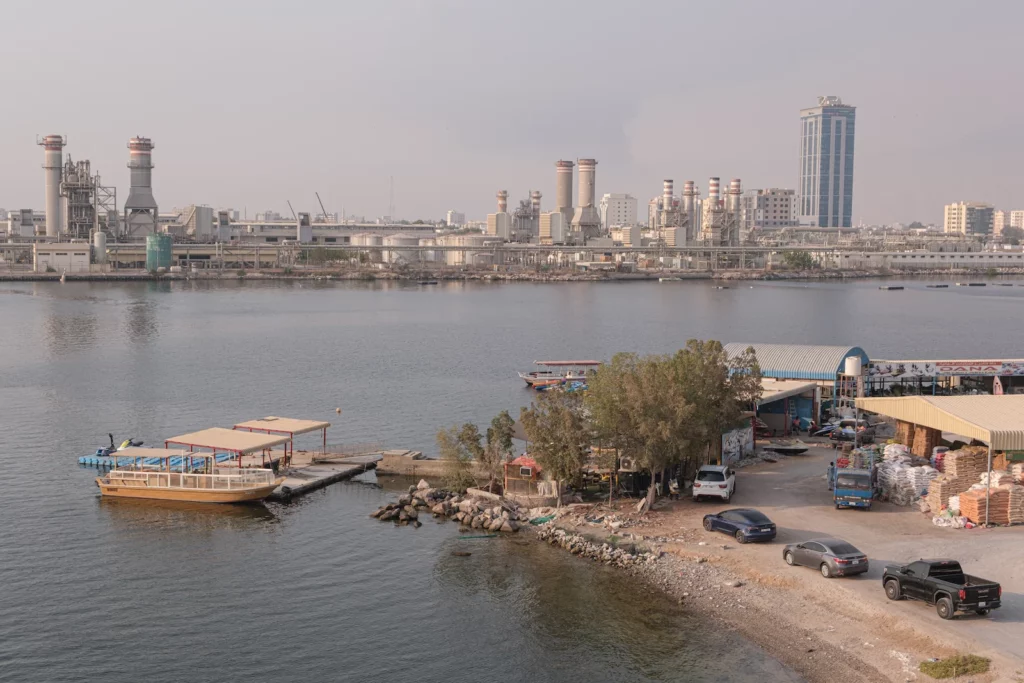
In Ras Al Khaimah, the Al Nakheel Power Station sits on the shore of a tidal creek, facing an open-air market on the opposite bank. It burns gas year-round to supply electricity to households and industries in the emirate, including cement and ceramics factories. Across the country, similar power plants dot the landscape, with gas – some of it imported, primarily from QatarU.S. Energy Information Administration – United Arab Emirates, 2023 – having powered the nation’s electricity for decades. The fuel, whose combustion emits between 0.4 and 0.6 kilogramsIntergovernmental Panel on Climate Change – Technology-specific Cost and Performance Parameters, 2018 of Earth-warming gases per kilowatt-hour on a global basis, accounted for over two-thirdsInternational Energy Agency – United Arab Emirates Electricity, 2023 of electricity generation in 2023, down from 98% five years earlier.
Gas for electricity plateaued
The United Arab Emirates’ historic reliance on gas for power generation reached a turning point in 2020 after the Barakah Nuclear Power Plant was connected to its national grid. The facility accounted for the bulk of the increase in national electricity output over the following four years, supplemented by solar, while gas use plateaued. With the nuclear power plant’s fourth and finalAbu Dhabi Media Office – Unit 4 of Abu Dhabi’s Barakah Nuclear Energy Plant connects to UAE power grid, 2024 unit online since 2024, attention has turned to the country’s solar power potential, which ranks among the world’s highest.Global Solar Atlas – Global Photovoltaic Power Potential by Country, 2020 The total installed solar capacity in the United Arab Emirates reached seven gigawattsGlobal Energy Monitor – Global Solar Power Tracker, 2026 in 2025, with another 19 gigawatts planned in the following years. To address the intermittency of solar energy, a grid-scale battery storageMasdar – UAE President witnesses launch of world's first 24/7 Solar PV, 2025 system has been announced to convert variable solar output into round-the-clock power.
Yet these additions have not replaced gas-fired generation; they have been added alongside the legacy infrastructure to meet rising demand driven by demographic growth and the buildout of energy-intensive infrastructure. The United Arab Emirates has positioned itself as a hub for artificial intelligence with 35 data centersEmirates NBD – UAE Data Center Capacity to Surge 165%, 2025 in operation as of 2025, and 17 more planned. Even as low-carbon sources are added, rising consumption has anchored fossil fuel-fired infrastructure in place, keeping the Al Nakheel Power Station burning gas along the creek.