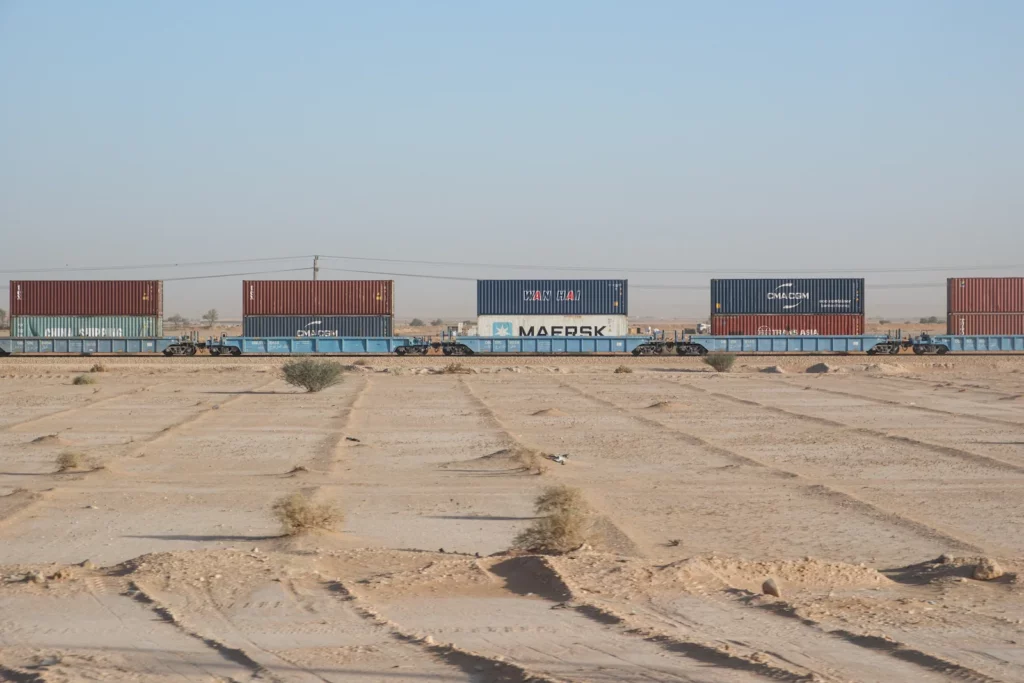
Running along a rail line crossing the vast Saudi Arabian desert, a container train passes near the village of At Tawdihiyah, at the junction between the Eastern Province, where most of the kingdom’s petroleum reservesAramco – Oil production are located, and the Riyadh region. The railway, inaugurated in 1951Saudi Gazette – A 1940s idea is on track as an engine of Kingdom's development, 2022 and built by the national oil company, then known as the Arabian American Oil Company,Aramco – Our history relies on fuel-powered locomotives. The fleet consumed a total of 51 million litresGeneral Authority for Statistics – Railway Transport Statistics, 2024 of petrol in 2024 to transport some 900,000 containers between King Abdulaziz Port on the shores of the Persian Gulf and the kingdom’s capital, Riyadh.
The Eastern Line is part of a rail network spanning multiple regions, with three passenger lines covering nearly 2,900 kilometres.General Authority for Statistics – Railway Transport Statistics, 2024 Saudi Arabia envisions cross-border connections to form a regional railway running along the Persian Gulf coastline and linking Kuwait, Bahrain, Qatar, Saudi Arabia, the United Arab Emirates and Oman. The project, approved in 2009,Economist Intelligence Unit – Looming risks may derail Gulf Railway project, 2023 has been repeatedly delayed, notably during the 2017–2021 political crisis between Qatar and a bloc including Saudi Arabia, the United Arab Emirates and Bahrain. It has also been held back by a bias toward domestic buildout over cross-border integration, reflecting decades of entrenched distrustAl Jazeera – Timeline of Qatar-GCC disputes from 1991 to 2017, 2017 between West Asian states. Mobility in the region has long been affected by political tensions, as evidenced by the mid-1920sUnited Nations Educational, Scientific and Cultural Organization – Hejaz Railway, 2015 halt of the Hejaz Railway that ran from Syria to Medina following political tensionsUnited Nations – Report of the Mandatory to the League of Nations, 1924 and a lack of maintenance.
Road transport dominance
While regional rail infrastructure has lagged, and domestic networks remain limited to a handful of lines, fossil fuel-powered trucks, passenger vehicles, and aircraft continue to dominate movement across the desert region. In 2024, 19 millionQatar News Agency – Tourism Sector Generates USD247.1 Billion in Value Added, 2025 people traveled between the six Gulf states, locked into the most polluting mobility options. That year, the only land border crossing between the United Arab Emirates and Saudi Arabia, the Al Ghuwaifat-Al Batha border post, handled 1.5 millionGeneral Authority for Statistics – Railway Transport Statistics, 2024 trucks. Shifting freight from road to rail is estimated to reduce Earth-warming gas emissions for every tonne transported by a factor of eight.Congressional Budget Office – Emissions of Carbon Dioxide in the Transportation Sector, 2022
At the national level, however, some countries have actively pursued railway development. The United Arab Emirates’s national network, Etihad Rail, consists of 11 passenger stations and stretches 900 kilometresEtihad Rail – Etihad Rail reveals details of the UAE’s full passenger railway network, 2025 from Al Ghuwaifat at the Saudi border to Fujairah on the Indian Ocean. And the regional project has not been shelved, with the Qatar-Saudi Arabia,Qatar Ministry of Transport – High-Speed Electric Rail Project for Passengers between Qatar and Saudi Arabia Strategic Step to Enhance Cooperation, 2025 Oman-United Arab Emirates,Hafeet Rail – The region’s first cross border rail network and Kuwait-Saudi ArabiaReuters – Kuwait signs design contract for Gulf rail link, 2025 interconnections showing renewed momentum in recent years. Freight transported via the Eastern Line since the early 1950s have demonstrated the viability of non-road transport in West Asia. More than half a century after the last Gulf state gained independence, will cross-border integration materialise?