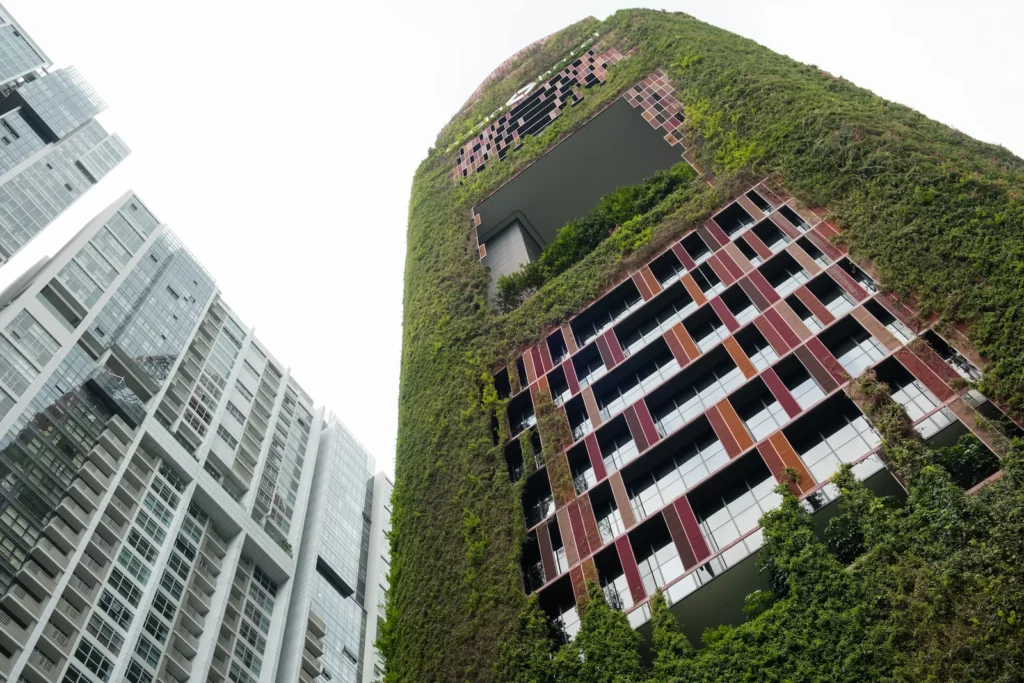
Among Singapore’s high-rise glazed towers, which trap heat and drive cooling consumption, a vertical garden comprising 21Council on Vertical Urbanism – A tall prototype for the tropics, 2018 plant species has been growing on the 190-metre-high facade of a hotel since 2016. The climbing plants, watered by an automatic irrigation system, are reported to lower the facade temperatures by up to 20°CWOHA Architects – Oasia Hotel Downtown, 2018 relative to neighbouring towers by reducingApplied Mechanics and Materials – Green Façade: Benefits and Threats, 2015 solar heat transmitted indoors through the building surface. Such natural cooling is of particular importance in Singapore, where annual average temperature stood at 28.4°C in the mid-2020s, with air temperatures rising 0.25°CMeteorological Service Singapore – Past Climate Trends, 2024 per decade since 1948.
For a country navigating one of the most acute land use dilemmas in the world, vegetalised facades and the planting of trees on rooftops are among the strategies explored to expand greenery cover without competing for ground-level space. Such vegetation layers help reduce elevated urban temperatures caused by the high concentration of heat-absorbing surfaces such as concrete, asphalt, steel and glass. Yet, the practice remains limited in scale. Only 213 buildings in Singapore had incorporated skyrise greenery by 2016. Besides greening, specialised glass coatingsJournal of Building Engineering – Experimental investigation on indoor thermal environment improvement and energy-saving of electrochromic window under Singapore's tropical climate, 2023 have also been deployed to limit solar heat gain.
Gas-powered thermal comfort
The vertical garden in the Tanjong Pagar area aligns with Singapore’s decades-long effort to incorporate vegetation into its urban fabric. The Garden City programme, launched in 1967 by then Prime Minister Lee Kuan Yew, led to the planting of hundreds of thousandsSingapore National Library – “Garden city” vision is introduced, 2015 of trees, alongside shading structures and water bodies. The government extended that commitment in 2020 by pledging to plant one millionSingapore National Parks Board – OneMillionTrees Movement, 2026 trees over the next ten years, prompting Singaporean newspaper The Straits Times to callThe Straits Times – How Singapore is rethinking nature in the city, 2025 the country’s greening a “leafy metamorphosis”. That domestic record, however, sits alongside a different one abroad, where Singaporean companies are involvedInternational Consortium of Investigative Journalists – Brands drop Singapore-listed palm oil giant after Deforestation Inc. exposé, 2024 in the destruction of primary forests to expand oil palm plantations.
Despite efforts to offset urban heat through vegetation, artificial cooling remains the dominant means of regulating indoor temperatures. Introduced to Singapore by American company Carrier in the 1930s,National University of Singapore – Introduction of Air Conditioning into Singapore, 2024 the technology spread across income brackets in the following decades, and was later describedChina Daily – Singapore's new city of the future is its greenest project yet, 2024 by Lee Kuan Yew as the “greatest invention” of the 20th century. By the early 2020s, eight out of tenSingapore Department of Statistics – Ownership of consumer durables, 2023 households in Singapore owned air-conditioners. The machines, powered by electricity produced by burning gas, make up about halfSingapore National Climate Change Secretariat – Air-con system efficiency primer, 2011 of the energy consumption in a typical building. Heat extracted by air-conditioners to cool interiors is expelledCarrier – How Do Air Conditioners Work? outdoors, where it compounds the urban warming the hotel’s vertical garden is designed to counter.