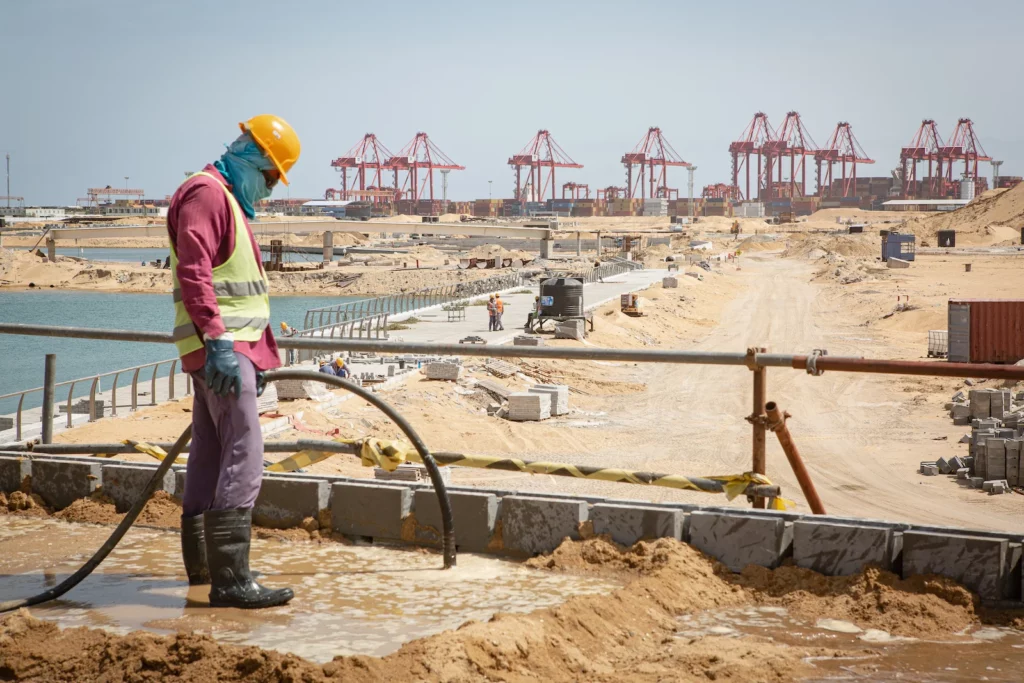
Standing under the midday sun, a construction worker toils at Port City Colombo on July 13, 2022. Earlier that day, President Gotabaya Rajapaksa fledDaily Mirror – President flees the country on a military jet, 2022 Sri Lanka, forced out by the economic and political crisis that ended his family’s grip on the South Asian island. The worker is among those constructing a special economic zone on land reclaimed from the Laccadive Sea. The project, fundedPort City Colombo – About Port City Colombo by Chinese investments, was launched in 2014China Daily – Presidents launch port city project, 2014 by Mahinda Rajapaksa, Gotabaya Rajapaksa’s elder brother, and Sri Lanka’s presidentParliament of Sri Lanka – Heads of State, 2026 at the time.
Next to the construction site is Port of Colombo, a deep-water facility ranked as South Asia’s secondLloyd's List – One Hundred Container Ports, 2025 busiest port, with berths deep enough to receive the world’s largest commercial ships. Its container terminal, operatedChina Merchants Port Holdings Company Limited – Timeline, 2013 by a Hong Kong-based port operator, underwent a major expansionGoogle Earth, 2026 in the 2010s with several new berths added. These investments extend a long-standing maritime link between China and the Indian Ocean region that spans more than two millenniaSpringer Nature – Neighborly Relations in a Rapidly Evolving World, 2024. The Sri Lankan coastline, positioned along the Indian Ocean’s trading routes connecting East and Southeast Asia to West Asia and Europe, was a node in the ancient maritime Silk Road trading network.
Revive the Silk Road
Chinese investments into Colombo’s port complex are part of the Belt and Road Initiative, a network of infrastructure projects launched by Chinese President Xi Jinping in 2013 to connect Asia, Africa and Europe across land and sea networks. Its maritime component, termedMinistry of Foreign Affairs of the People's Republic of China – Full text of President Xi's speech at opening of Belt and Road forum, 2017 “21st Century Maritime Silk Road” by Xi Jinping, includesMinistry of Foreign Affairs of the People's Republic of China – Jointly Building the Belt And Road, 2018 Sri Lanka and functions as a key South Asian node in the Chinese-led network that India has declinedThe Hindu – India refuses to endorse China’s Belt and Road Initiative, 2021 to join. According to official statementsThe Belt and Road Initiative – Vision and Actions on Jointly Building Silk Road Economic Belt and 21st-Century Maritime Silk Road, 2015, the project aims to “tap market potential” in participating countries, and integrate China “deeper into the world economic system”, among other goals. Building on historical trade routes, the projects act as conduits for the export of China’s industrial output, including to India. The Port of Colombo is primarily a transshipment hub, with over 80%Daily Mirror – Colombo Port starts 2026 strong as transshipment surges 15%, 2026 of containers handled at the terminal re-exported, the majority to India.
The composition of traded goods, however, has shifted from natural materialsUnited Nations Educational, Scientific and Cultural Organisation – About the Silk Roads in ancient times, including silk, agricultural products, wood, and many others, to flows of products derived from fossil fuels. China was the world’s largestUnited Nations Trade and Development – Plastics trade by partner, 2025 exporter of plastics and manufactured plastic goods in 2022, shipping more than 87 million tonnes of the synthetic material. The trade infrastructure under construction in Colombo amid Gotabaya Rajapaksa’s escape is embedded in shipping networks. The global container ship fleet, estimated at 5,700United Nations Trade and Development – Merchant fleet by flag of registration and by type of ship, 2025 vessels in 2022 and propelled by fossil fuels, channels goods to consumer markets. It contributes to sustaining a global manufacturing system that has geographically decoupled consumption from the environmental impacts of production.