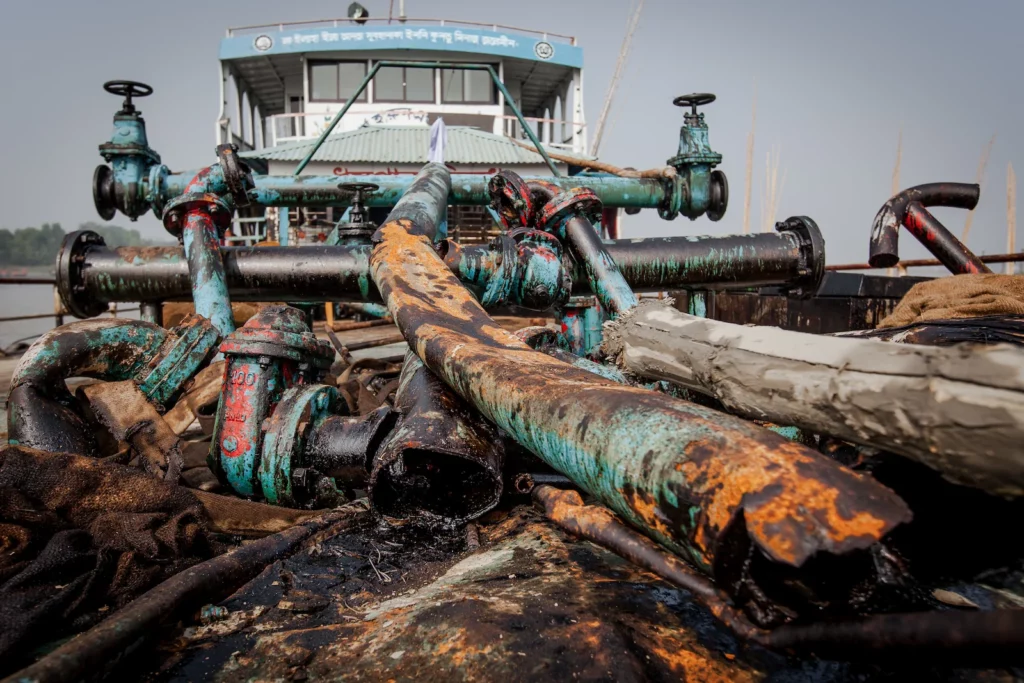
The oil-stained deck of the salvaged tanker OT Southern Star 7 bears traces of the cargo it spilled into the waterways of the northeastern Sundarbans as it sank in early December 2014. The Bangladeshi vessel was carrying more than 350,000IncidentNews – Sundarbans Oil Spill, 2014 litres of heavy fuel oil for a subsidiaryThe Daily Star – Oil spills into river as tanker sinks at Sundarbans, 2014 of the state-owned Bangladesh Petroleum Corporation. The oil spread into the largest single patch of mangrove forest in the world, a UNESCO World Heritage Site home to nearly 700United Nations Educational, Scientific and Cultural Organisation – The Sundarbans, 1997 animal species, including Bengal Tigers, Saltwater Crocodiles, and Irrawaddy Dolphins. Shared between Bangladesh and India, and covering the delta of the Ganges, Brahmaputra and Meghna rivers, the Sundarbans meansNational Geographic – Building tomorrow in the Sundarbans, 2019 “beautiful forest” in Bengali.
The OT Southern Star 7 was one of eightThe Daily Star – Sundarbans ecology braces for disaster, 2018 commercial ships that capsized in the Sundarbans between 2013 and 2018, pollutingMongabay – Ship carrying 1,235 metric tons of coal sinks in Sundarbans, 2016 the fragile ecosystem with hundreds of tonnes of oil, coal and fertiliser. Those incidents prompted the United Nations Development Programme representative in Bangladesh to callReliefWeb – Statement by Pauline Tamesis, 2014 for “a complete ban on the movement of all commercial vessels” in the Sundarbans. Yet, the annual shipping traffic through the mangrove forest was estimated at 10,000The Daily Star – Stop disturbing the Sundarbans, 2024 voyages in 2022. The waterway where the OT Southern Star 7 sank, the Shela river, recorded the transit of about 400Mongabay – Sundarbans still reeling from effects of December oil spill, 2015 commercial ships on the first day it reopened to navigation.
Degradation of a carbon sink
Roughly 20%International Journal of Fisheries and Aquatic Studies – Impact of oil spill in the Bangladesh Sundarbans, 2017 of the oil spilled by the OT Southern Star 7 was collected manually from soils, water and mangrove roots by villagers in the following weeks. The recovery effort addressed only a fraction of a broader systemic issue. An estimated one millionScientific Data – Enhanced global oil spill dataset from 1967 to 2023 based on text-form incident information, 2025 tonnes of crude oil enters marine ecosystems annually, through accidental spills, commercial shipping discharges, oil drilling leaks, runoff from land-based human activities, emergency kerosene dumping by aircraft, and other sources. A 2022 investigationDeutsche Welle – Cargo ships dumping oil into the sea go unpunished, 2022 revealed that oily wastewater is routinely discharged into the ocean by commercial fleets, although the practice, known as bilge dumping, has been prohibited worldwide since 1983International Maritime Organisation – International Convention for the Prevention of Pollution from Ships, 2005. Oil is one of several substances the global shipping industry discharges into marine environments, including tiny plastic particles released by hull coatings as vessels sail.
Heavy fuel oil, the substance that contaminated the Sundarbans in 2014, is a residue from crude refining often used in industrial processes and power generation. Demand for the fuel reflects the nearly six-foldInternational Energy Agency – Bangladesh energy mix, 2023 increase in energy consumption in Bangladesh’s industrial sector in the two decades to 2020. The Sundarbans faces additional contamination from heavy metals emitted by fourGlobal Energy Monitor – Global Coal Plant Tracker, 2026 coal-fired power plants in operation in the mangrove area. The largest, the Payra Power Station, burnt 14.5 millionBangladesh-China Power Company – Annual report, 2025 tonnes of coal imported from Indonesia between 2019 and 2025. But the expansion of human activities in the mangrove area, from ships plying its rivers to deforestation, poaching, agriculture and construction, has come at a cost. Those pressures have degraded an ecosystem whose total area has halved since 1770Trees, Forests and People – Paradigm shift in the management of the Sundarbans mangrove forest of Bangladesh, 2021 and which, as of 2010, sequestered about about 10%Bangladesh Forest Department of Bangladesh’s annual emissions of carbon dioxide.