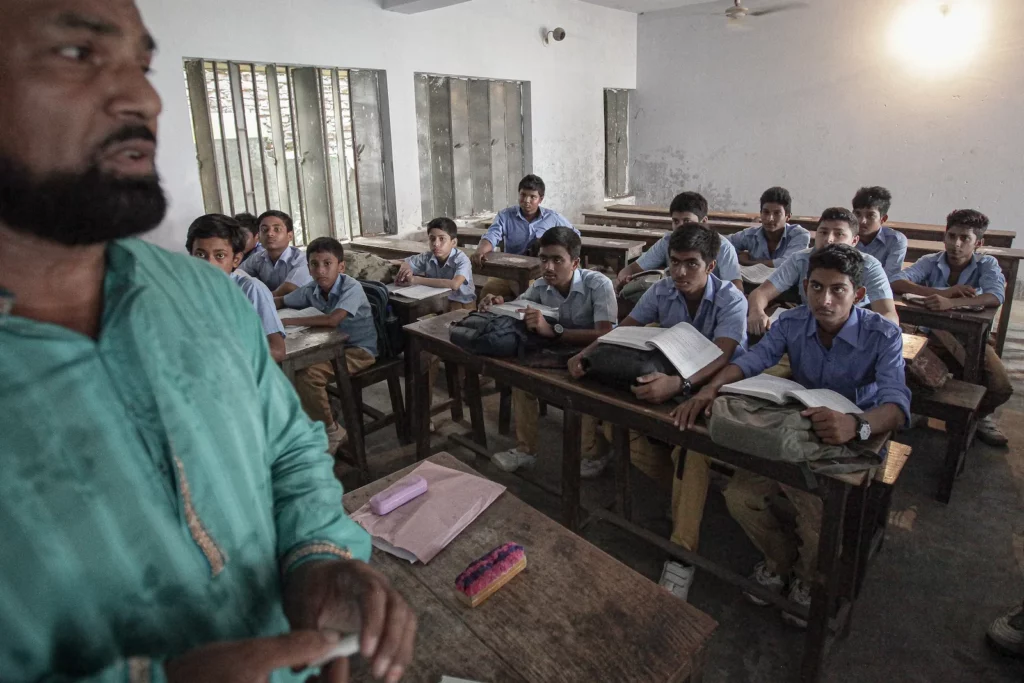
A group of Bangladeshi schoolchildren wearing uniforms attend a class at the Pogose School. Established in Dhaka in 1848The Daily Star – An Armenian legacy in Old Dhaka, 2019 by Joakim Gregory Nicholas Pogose, an Armenian merchant, the educational institution has educated successive generations of Bangladeshis. Beyond institutions such as Pogose School, formal education expanded nationwide with measurable outcomes. The country’s literacy rate, abysmally low in the mid-19th century, reached 18%Ministry of Education of Bangladesh – EIU Situation in Bangladesh, 2019 in 1971 when Bangladesh gained its independenceHouse of Commons Library – Bangladesh: the International Crimes Tribunal, 2012 from Pakistan, then 60% in 2010.
Those students at Pogose School in August 2014 were part of a cohort of 60 millionUnited Nations Data Portal – Population by age and sex, 2026 people aged under 18, a population group that will shape day-to-day life in Bangladesh well into the mid-21st century. The South Asian country, already one of the most denselyUnited Nations Data Portal – Population density, 2026 populated in the world, is projected to cross the 200 million inhabitants mark in the late 2030s. This demographic expansion, amid rapidly risingWorld Bank – GDP per capita, 2024 living standards, will place additional pressure on the country’s ecosystems. The capacity of Bangladesh’s lands and oceans to provide food and biomaterials, as well as accommodate urban infrastructure and absorb carbon dioxide (CO2), is already less than a fifthGlobal Footprint Network – Ecological Deficit/Reserve, 2024 of the world average per person.
Missed opportunity
In this context, the National Curriculum and Textbook Board introduced environmental education. The students at Pogose School were among the first to be taught about climate change-related issues after the topic had been added to primary and secondary curricula a year earlierMonitoring and Evaluating Climate Communication and Education – Climate change communication and education, 2022. A decade later, however, educational institutions in Bangladesh still “fail largely in making the students realise the problem posed by environmental hazards”, and teachers exhibit “a lack of knowledge” in environmental education, a University of Chittagong studyUniversity of Chittagong – Environmental education for sustainable developmentin Bangladesh and its challenges, 2023 found. More than two-thirds of students surveyed said their awareness of the environment is inadequate, and corporate environmental crimes occurring in Bangladesh, including pollution from industries like tanneries, brick kilns and ship-breaking yards, are omitted from curricula.
Bangladesh’s underdeveloped environmental education is a missed opportunity. It leaves the country’s future adult population ill-equipped to comprehend a convergence of demographic and consumption pressures that are accelerating the depletion of domestic ecosystems. Traditional curricula have historically contributedUniversiti Putra Malaysia – Education for sustainable consumption, 2020 to reinforcing the social acceptance of resource-intensive lifestyles that place growing demands on land, energy, and materials. That limited environmental literacy has coincided with a shift towards resource- and waste-intensive urban lifestyles as the share of Bangladeshis living in cities has quadrupledWorld Bank – Urban population, 2024 since the early 1970s. The schoolchildren at Pogose School have left the classroom largely unaware of the environmental implications of the choices they would later make as adults.