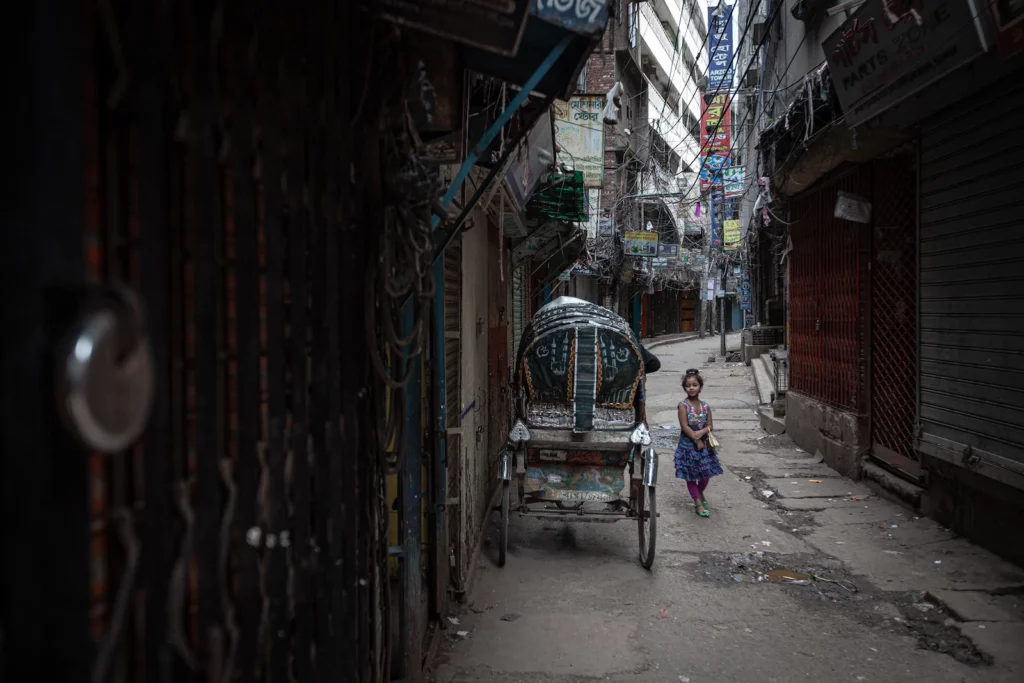
As millions of Bangladeshis observed a public holiday in late July 2014 marking the end of the Islamic holy month of Ramadan, a three-wheeled cycle rickshaw stood still on an empty street of Dhaka. The scene is unusual. The Bangladeshi capital city is usually heavily congested and has been labelled the “slowest”National Bureau of Economic Research – The fast, the slow, and the congested, 2023 in the world. By 2026, average vehicle speed was estimated at five kilometresBangladesh Sangbad Sangstha – Traffic speed rises in city as PM, top officials follow signals, 2026 per hour, four times slowerWorld Bank – A New Urban Development Paradigm Eastward, 2018 than just two decades earlier. In several parts of Dhaka, pedestrians now move faster than road-based transportation during the day.
Authorities have attempted to restore mobility across the city. Dhaka’s first mass rapid transit system began operationsThe Daily Star – Metro moment is finally here, 2022 in 2022, and additional lines are under construction. Road transport also expanded, with the construction of flyovers and expressways,Prothom Alo – Dhaka Elevated Expressway being inaugurated today, 2023 while the number of buses and motorcycles increased three- and six-foldBangladesh Road Transport Authority – Number of registered motor vehicles in Dhaka, 2023 respectively between 2010 and 2025. Still, population growth and the increasing adoption of individual cars have outpaced efforts to end paralysing traffic congestion. Over the first quarter of the 21st century, Dhaka’s population surged by 19 millionUnited Nations Department of Economic and Social Affairs – World Urbanization Prospects, 2025 people, sharply increasing demand for urban mobility across the city.
“Tesla of Bangla”
One of the defining features of road transport in Dhaka is human-powered mobility that has largely disappeared from other major Asian cities, displaced by engine-powered options. The city is dubbed the rickshaw capital of the world in reference to its fleet of three-wheeled vehiclesUnited Nations Educational, Scientific and Cultural Organization – Rickshaws and rickshaw painting in Dhaka, 2023 powered by a person pedalling at the front. It is estimated that 500,000Guinness World Records – Most cycle rickshaws in one city, 2014 to over one millionThe Daily Star – Breaking the cycle/rickshaw, 2019 cycle rickshaws run on its roads, accounting for more than one in threeMinistry of Housing and Public Works – Dhaka Structure Plan 2016-2035, 2015 trips, most of them unregistered since local authorities stopped issuing new licenses in 1986The Daily Star – Breaking the cycle/rickshaw, 2019. In recent years, battery-powered rickshaws nicknamed the “Tesla of Bangla”The Daily Star – Tesla of Bangla!, 2024 have joined the fleet of cycle rickshaws, though authorities have sought to curb their useThe Daily Star – Rickshaws, rights, and the rulebook, 2024 following accidents.
But their ubiquity has not spared rickshaws from criticism. They are often blamed by local officials and transportation analysts for contributing to traffic congestion, and portrayed as relics that should disappear to make way for a “rickshaw-free”University of Cambridge – Earning Money as the Wheels Turn Around, 2021 city. The Dhaka Structure Plan 2016-2035 plans to establish road hierarchy, and limit rickshaw useMinistry of Housing and Public Works – Dhaka Structure Plan 2016-2035, 2015 to “local roads only” to “eliminate unequal competition between slow and fast-moving vehicles.” This portrayal contrasts with the acceptance as part of Dhaka’s mobility mix of private vehicles that are among the heaviest consumersInternational Transport Forum – Cars and Space Consumption Rethinking the Regulation of Urban Mobility, 2015 of urban space and among the most polluting per person.
Unlike cars and buses powered by imported fossil fuels, cycle rickshaws do not release exhaust and therefore help contain air pollution in a city where PM2.5 concentrations measured in 2024 were already more than 15 times higherIQAir – World's most polluted cities, 2024 than the levels recommended by the World Health Organization. The young girl who stood beside the parked rickshaw at the end of Ramadan in 2014 is part of a generation that will inherit a city struggling with heavily polluted air, while the future of one of its cleaner forms of mobility remains under debate.