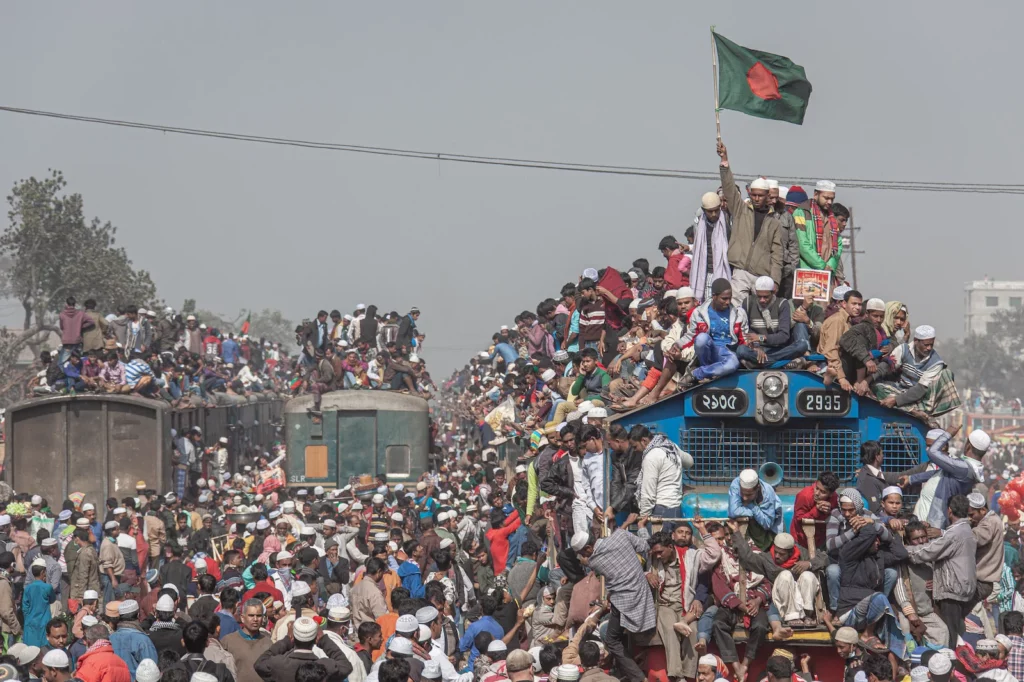
After the 2015 edition of Bishwa Ijtema concluded with a final collective prayer, tens of thousands of Muslim pilgrims pushed through dust-filled air toward the trains that would carry them home. The annual prayer gathering has been held since 1967Bangladesh Sangbad Sangstha – First phase of Bishwa Ijtema begins tomorrow, 2023 in Tongi, north of Dhaka, the Bangladeshi capital. It drew fiveThe Telegraph – What is the festival of Bishwa Ijtema and where is it held, 2016 million devotees annually in the early 2010s, and ranks among the largestU.S. Embassy in Bangladesh – Bishwa Ijtema – Personal Safety Reminder, 2025 Muslim gathering in the world. Every year, Bangladeshi authorities expand mass transit services to move millions of attendees, adding dozens of special trains and hundreds of buses on routes serving the venue.
With passengers far exceeding train capacities on that day, thousands resorted to riding on the roofs and hanging on the sides of carriages. The handlingThe Daily Star – BR to launch 11 pairs of special trains for Ijtema, 2024 of Bishwa Ijtema passenger flows represents the most operationally demanding event in Bangladesh Railways’ annual operations. The state-owned rail operator ran a network spanning 3,400Bangladesh Railway – Information Book, 2023 kilometres that connected more than 500 stations, and served three-quarters of districts across the South Asian country as of 2023. The network’s reach is matched by its environmental footprint. The company’s fleet of locomotives, all powered by fossil fuels, contributes to the annual emissions of 15 millionInternational Energy Agency – Bangladesh, 2023 tonnes of carbon dioxide (CO2) by the transport sector in Bangladesh.
Anticipating the 200 million mark
Yet, the episodic headline-grabbing Bishwa Ijtema crowd masks a structural decline in railway use across the country. The number of passengers carried by the Bangladesh Railways annually stood at 74 millionBangladesh Railway – Bishwa Ijtema – Information Book, 2023 in 2023, a figure similar to the annual traffic recorded half a century earlier. In relative terms, however, rail’s role in passenger mobility has diminished substantially in recent decades. The share of rail in non-urban passenger trips has plunged from an estimated 30% to 3%Asian Development Bank – South Asia Subregional Economic Cooperation Railway Connectivity Investment Program, 2017 since the mid-1970s. Meanwhile, mobility systems shifted decisively toward road-based transport, which now dominate intercity passenger movement. The total number of registered motor vehicles in Bangladesh increased nearly five-fold between 2010 and 2025 to 6.6 millionBangladesh Road Transport Authority – Number of registered motor vehicles in Bangladesh, 2025 units.
To counter market share in structural decline and infrastructure ageing, Bangladesh Railways is being modernisedBangladesh Sangbad Sangstha – Govt undertakes Tk 2,028cr railway rehabilitation project to modernise western zone rail network, 2026 under the government formed after Prime Minister Sheikh Hasina was ousted in a student-led uprising in August 2024. The programme includes measures to address a “severe”International Railway Journal – Bangladesh secures locomotive funding, 2026 shortage of locomotives. Efforts to revive demand for rail travel come amid the prospect of a structural increase in demand for passenger travel in the coming years, driven by continued population growth and rising living standards. Bangladesh is projected to cross the 200 millionUnited Nations – Bangladesh Total population by sex, 2026 inhabitants mark in the late 2030s, increasing one of the highestUnited Nations – Population density, 2026 population densities in the world and further intensifying operational pressure during Bishwa Ijtema.