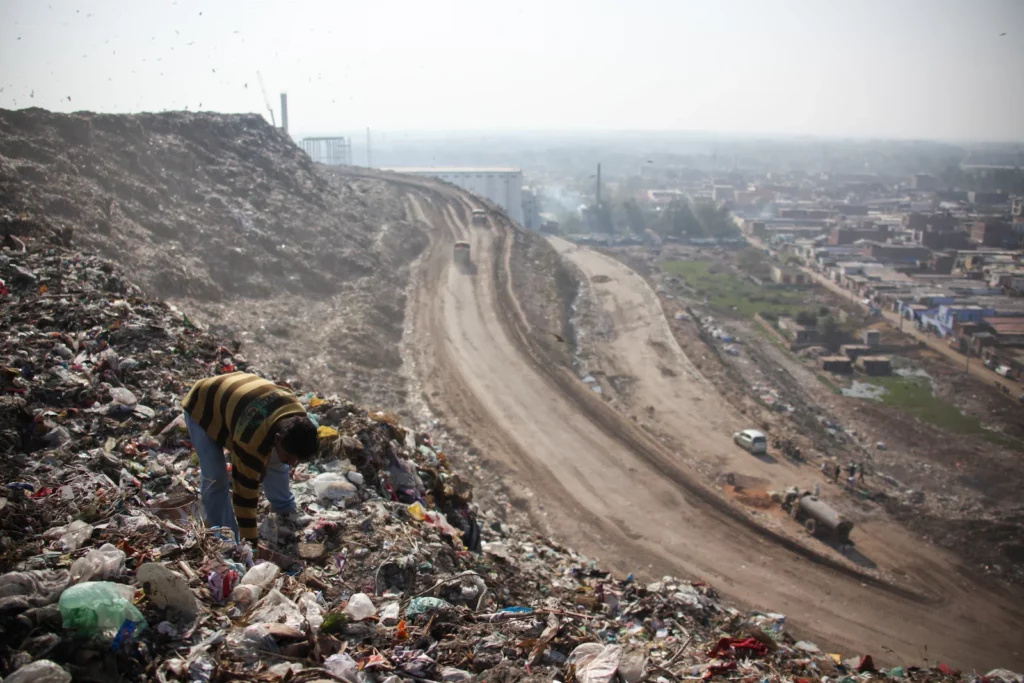
Standing atop towering piles of discarded goods in the eastern district of Delhi, an Indian ragpicker looks for metal, cardboard and plastics that can be sold to scrap dealers. Like him, dozens of informal workers scavenge amid the stench and toxic fumes rising from decomposing waste, while hundreds of crows and birds of prey circle above. The Ghazipur landfill, established in 1984Lok Sabha – Relocation of Ghazipur Landfill, 2025 and commonly dubbed Trash Mountain, has grown into a 72-metre-highAQI – Methane Emissions from Delhi’s Landfills, 2025 mound. Four decades after it opened, the landfill continues to rise, with about 2,500 tonnesThe Hindu – Gaps in MCD’s plan to clear Ghazipur dump by 2028, 2025 of garbage added daily.
Environment Minister Manjinder Singh Sirsa pledged to clearThe Indian Express – Garbage mountains in Delhi to be cleared by 2028, 2025 Delhi’s “garbage mountains” by 2028, but the Ghazipur landfill is one node in India’s vast network of 3,200 repositoriesEconomic Advisory Council to the Prime Minister – Challenges of Solid Waste Management in Urban India, 2024 for waste disposal. The South Asian country generates about 160,000 tonnesCentral Pollution Control Board – Annual Report, 2022 of solid waste per day, about a fifth of which is sent piling up in landfills. The increase in per capita waste mirrors the nearly doublingWorld Bank – Urban population India, 2024 since 1960 of the share of India’s population that lives in urban areas. Data show that Indians living in large cities generate five timesEconomic Advisory Council to the Prime Minister – Challenges of Solid Waste Management in Urban India, 2024 more waste than those living in small towns. The entrenchment of a throwaway culture in urban communities has contributed to overwhelming landfills, a trend acknowledged by the Economic Advisory Council to India’s Prime Minister. It concludedEconomic Advisory Council to the Prime Minister – Challenges of Solid Waste Management in Urban India, 2024 that it is “critical to educate the public on the significance of their part” in the growing waste burden.
Leaking Earth-warming methane
Besides public health concerns in nearby residential areas, including respiratory issues, skin infections and cancer risks, the Ghazipur landfill leaks an estimated 156 tonnesAQI – Methane Emissions from Delhi’s Landfills, 2025 of methane per hour. The invisible and odourless gas contributes to warming Earth’s atmosphere, like carbon dioxide (CO2), with a global warming potential 28 timesU.S. Environmental Protection Agency – Methane Emissions, 2025 greater than CO2 over 100 years. Landfills are often considered a cheap disposal method, because long-term environmental damage is not factored in. Landfills lacking methane capture and systems to collect fluids that form when rainwater percolates through waste materials release toxic substances into soil and water.Nature – Identification of prevalent leachate percolation of municipal solid waste landfill, 2024 In Delhi, this “garbage juice” flows into the Yamuna River, a tributary of the Ganges.
Back at the Ghazipur landfill, many of the goods ragpickers laboured through were marketed as recyclable by the companies that manufactured them. Yet, the promise of recycling, often used to excuse consumption, is a myth. At best, recycling postpones the day when waste ends up in landfills or in nature. Paper can be recycled five to sevenU.S. Environmental Protection Agency – Facts and Figures, 2016 times as fibers degrade during each recycling cycle, while plastics can be recycled only a handful of times.Saint Louis City Recycles – How Many Times Can This Be Recycled, 2020 What follows is downcycling into lower-value products, before waste is ultimately pushed to the periphery of consumer society, where marginalised workers survive on what the city has cast aside.