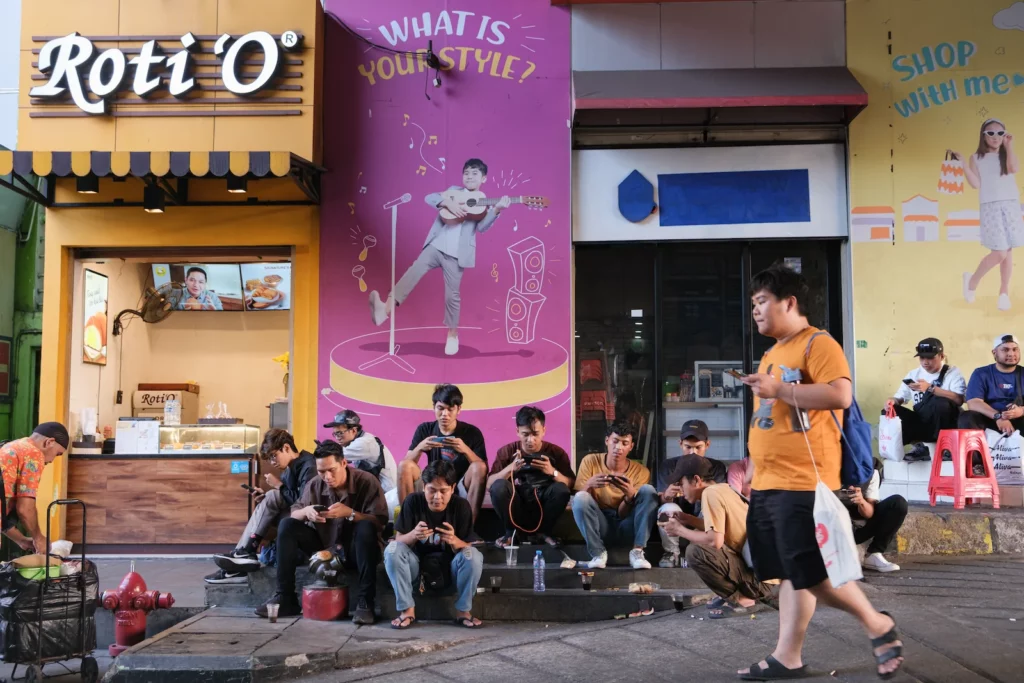
In the bustling streets adjacent to the largest textile wholesale market in Southeast Asia, Tanah Abang, a shopper walks by a dozen men focused on their smartphones. The trade area was founded in present-day Jakarta in 1735Springer – Textile and texture in Tanah Abang Market, 2025 after approval was granted to Dutch East India Company (VOC) representative Justinus Vinck. Throughout its three-century-long history, Tanah Abang, today frequented by an average of 35,000 peopleKompas – Jakarta’s Tanah Abang Market Swamped By Idul Fitri Holiday Shoppers, 2021 a day, has offered a window, through clothing trends, into evolving socio-cultural dynamics and consumption patterns.
The group of seated men that day in the Tanah Abang area belongs to one of the first digital native generations in Indonesia, now a dominant force in the country as more than halfBadan Pusat Statistik – Jumlah Penduduk Menurut Kelompok Umur dan Jenis Kelamin, 2021 the population is under 35. Their demand for tech devices and digital services has made Indonesia one of the largest consumers of smartphones in the world, with about 40 millionInternational Data Corporation – Indonesia’s Smartphone Market Posts Strong Recovery with 15.5% Growth in 2024, 2025 units sold in 2024.
Proliferation of options
Less visible is the vast waste stream that has grown in parallel. The lifespan of smartphones is limited, in large part due to planned obsolescence, and marketing campaigns engineered to entice the purchase of new models. This results in the discarding in landfills of millions of smartphones every year. Indonesia recycled only 2.6%Ministry of National Development Planning – Circular Economy National Roadmap & Action Plan 2025–2045, 2024 of the 2.1 million tonnes of electronic waste it generated in 2023, and less than one five-hundredth of the critical raw material that e-waste contains have been recovered. Meanwhile, the extraction of new natural resources fuels the electronic goods industry’s supply chains at a steep environmental cost.
At Tanah Abang, the advertisement reading “What is your style?” in the backdrop of the seated men embodies the idea of infinite choice that has defined the 21st century so far. This logic is reflected in the number of distinct Android devices that jumped six-fold between 2012 and 2015 to reach over 24,000 modelsPC Mag – Report Finds 24K Distinct Android Devices, 2015 in use globally. Numbers are even higher in the fashion industry, with Chinese-founded clothing retailer SHEIN listing 2,000 to 10,000Harvard Business School – Report Finds 24K Distinct Android Devices, 2015 new references per day in the early 2020s. The proliferation of options has reshaped consumerism around the continual pursuit of individual tastes.