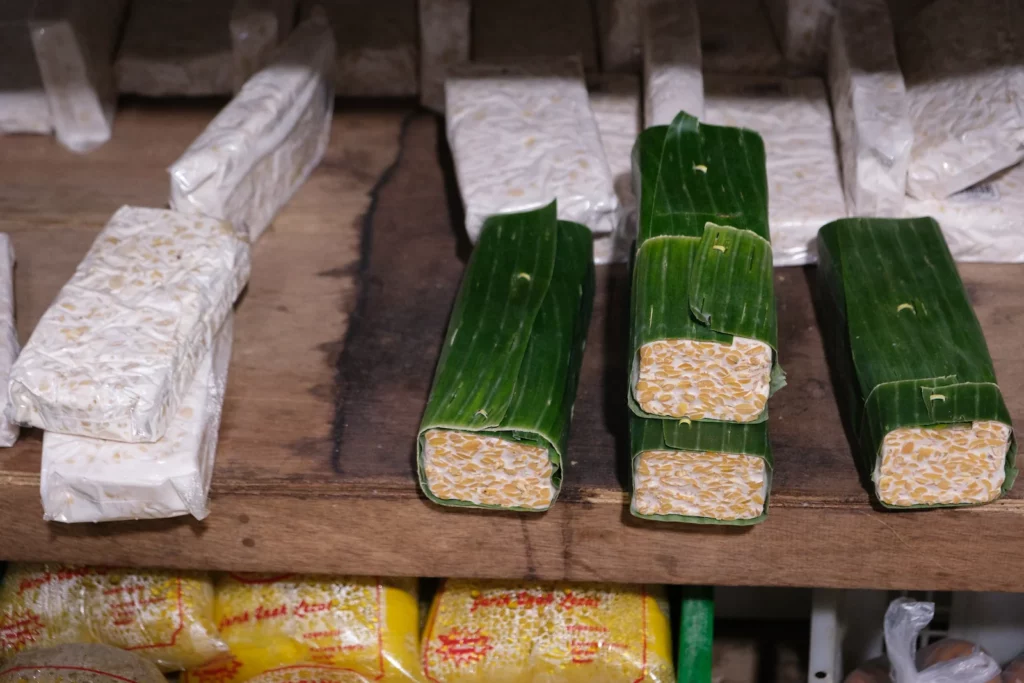
As the sun sets over a neighborhood located at the entrance of a vast industrial area that spans the eastern fringes of the Greater Jakarta metropolitan area, workers returning home stop at a local corner store. Blocks of tempeh that line the shelves that evening illustrate the transformation of food packaging in Indonesia, extending beyond Cikarang. Those packs of the nutrient-rich traditional Indonesian food made from fermented soybeans are either sold wrapped in biodegradable banana leaves, or in vacuum-sealed plastics thrown away after use.
In Southeast Asia’s humid climate, food packaging has long played a key role in extending shelf life and protecting food from humid climatic conditions that accelerate the growthNational Centre for Infectious Diseases – Climate Change and Infectious Diseases, 2024 of bacteria in food and cause spoilage. In addition to their functional role, natural leaves often contribute to adding flavor and aroma to the food they enclose.
Locally sourced natural materials that compost naturally after use, chiefly banana leavesGlobal Scientific Journals – Banana Leaves as A Natural Food Packaging, 2021, valued for their foldable structure, dominated the Indonesian food packaging scene for centuries. Other materials included the leaves of teak trees and of taro and pandan plants. Nasi bungkus is a common example: a takeaway meal in Indonesia and Malaysia consisting of rice and side dishes wrapped in a banana leaf.
Unaccounted end-of-life costs
But traditional packaging has been marginalized in recent decades as the fossil fuel industry engineered plastic dependence in the food supply chain. In the present day, nearly a thirdOECD – Regional Plastics Outlook for Southeast and East Asia, 2025 of total plastics consummed in Indonesia is used for packaging. The synthetic material is often deemed cleaner and more hygienic, despite containing harmful chemicals that can leach into food, some of which are suspected carcinogensFrontiers – Potential mammary carcinogens used in food contact articles, 2024.
This shift has coincided with a decline in the passing of natural packaging techniques from one generation to the next, causing traditional know-how to be forgotten, according to researchResearchGate – The Culture of Packaging Traditional Balinese Snacks with Banana Leaves, 2024 conducted in Bali. The country’s Ministry of Tourism highlights on its websiteKementerian Pariwisata Republik Indonesia – 7 Authentic Traditional Indonesian Food Packaging, 2024 seven “authentic” food packaging that are still in use despite the “dominance of plastic materials”.
At the corner store in Cikarang, all tempeh blocks are priced uniformly, regardless of the wrapping option. This absence of differentiation prevents purchasing decisions from taking into consideration the full cycle cost. Indonesia generates roughly 7.8 millionWorld Bank – Stemming the Plastics Tide in Indonesia, 2022 tonnes of plastic waste annually, of which up to 1,3 millionDuke University's Nicholas Institute – Plastic Pollution Policy Country Profile, 2022 tonnes ends up in the ocean, where they break down into microplastic pollution. These tiny plastic particles have been shown to impair the growthScienceDirect – Impacts of microplastics on marine organisms, 2022United Nations Environment Programme – Everything you should know about microplastics, 2025 of phytoplankton, the base of the aquatic food web. In the absence of pricing mechanisms that reflect end-of-life costs, plastic wrappings remain priced below their full cost, allowing them to displace biodegradable options on store shelves.