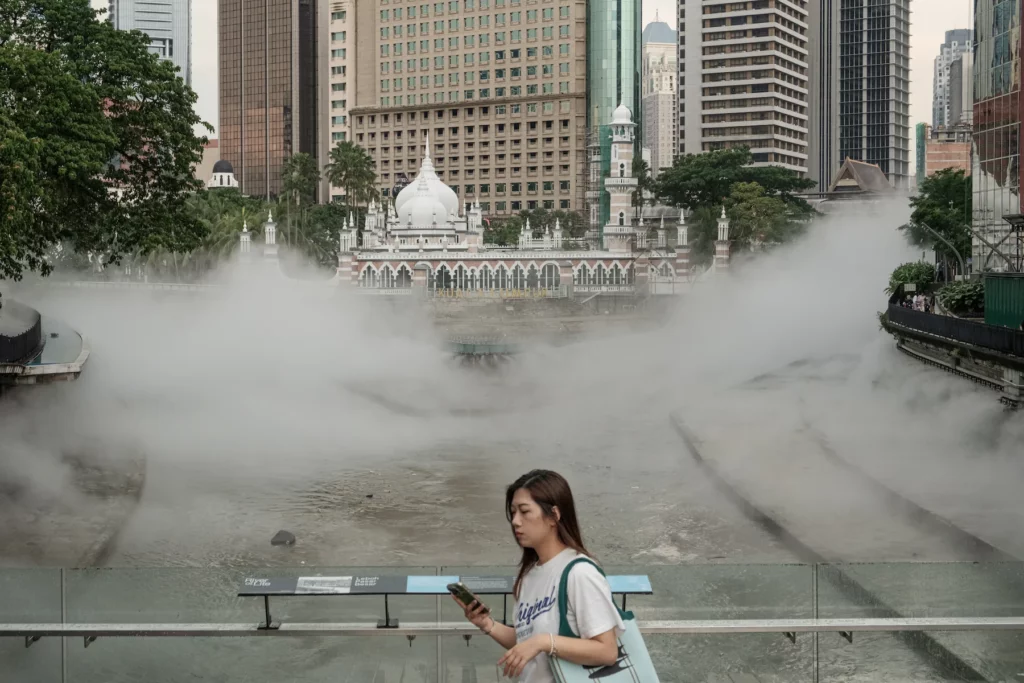
Each day, a theatrical mist envelops Kuala Lumpur’s historic district in the late afternoon, with blue lighting added in the evening. The installation is part of the River of Life project, which has sought since 2011River of Life – Project Background & Purpose to “rejuvenate” the banks of the watercourses that flow through the Malaysian capital city. Though popular with tourists, the rivers remain marginal to everyday social life for Malaysians, partly due to the lack of boating activity and persistent pollution. The streams served as a dumping ground for decades, including for sewageThe Straits Times – Malaysia’s ambitious River of Life project struggles to meet deadline despite $1.2 billion spent, 2024 and solid wastes. Pollution levelsJournal of Water Resources Management – Klang River System Water Quality Modelling and Improvement for the River Of Life, 2023 remained moderately elevated in the mid-2020s, with water qualitySelangor Maritime Gateway – Klang River Water Quality Index, 2025 still classified as unsuitableSelangor Maritime Gateway – National Water Quality Standards for Malaysia, 2023 for body contact and requiring “extensive treatment”.
The governmental project has not reversed the fact that Kuala Lumpur’s rivers have been reduced to engineered channels within the city’s urban fabric, a legacy of their concrete channelisation over the last decadesMalaysia’s Ministry of Natural Resources and Environment – Urban Rivers in Transition of the 20th century to mitigate flood risksThe Straits Times – KL as you have never seen it before, 1971. The sealing of natural soils under concrete has not been confined to the watercourses. As Kuala Lumpur’s population surged six foldRitsumeikan University – Ninety Years of Urbanization in Malaysia, 2000OpenDOSM – W.P. Kuala Lumpur Kawasanku, 2026 in the six decades following Malaysia’s 1957 independence, new buildings, housing blocks, and asphalt-paved road networks proliferated across the city’s periphery. The urban expansion has come at the expense of green spaces, whose share of Kuala Lumpur’s urban area declined from 53 to 20%United Nations Human Settlements Programme – World Cities Report, 2024 in the three decades leading to 2020.
Vestiges of a distant past
Framed by the River of Life’s theatrical mist, Jamek Mosque, built in 1909, marks the convergence of the Klang and Gombak rivers. The joining of the two waterbodies gave the city its name: Kuala Lumpur meansEducation Malaysia Global Services – Kuala Lumpur “muddy confluence” in Malay. Those rivers were also at the origins of Kuala Lumpur’s early rise after its founding as a Chinese tin mining settlement in 1857MyHometown – Kuala Lumpur history, as they served as a supply route to mining operations. But the silvery-white metal, which Malaysia was the world’s largest producer for over a centuryThe New York Times – In Malaysia, the tin capital, crisis is worrisome, 1985, retreated to the margins of Malaysia’s economy in the 1990sEconomic History Malaysia – About tin mining. Since then, the watercourses have stood as a vestige of a distant past, flowing, largely unnoticed, through a city that no longer depends on them.
Efforts to restore rivers that once structurted daily life reveal the extent to which ecological systems have been marginalised over the last two centuries. Across Malaysia, human population density per square kilometre has more than quadrupledWorld Bank – Population Density Malaysia, 2023 since the 1960s, resulting in a rise in the share of land covered by built-up areas. Meanwhile, tin mining has been followed by agricultural activities that wipe out forest ecosystems to monetise lands. Oil palm plantations, largely operated as industrial-scale monocultures, covered more than one-sixthUnited States Foreign Agricultural Service – Palm Oil, 2026Malaysia Biodiversity Information System – Malaysia Geographical of Malaysia’s total land area in the mid-2020s. As River of Life claims to “reconnect the city, the river and the people”, urbanisation coupled with agricultural expansion have contributed to a reduction in Malaysians’ direct interactions with the natural environment.