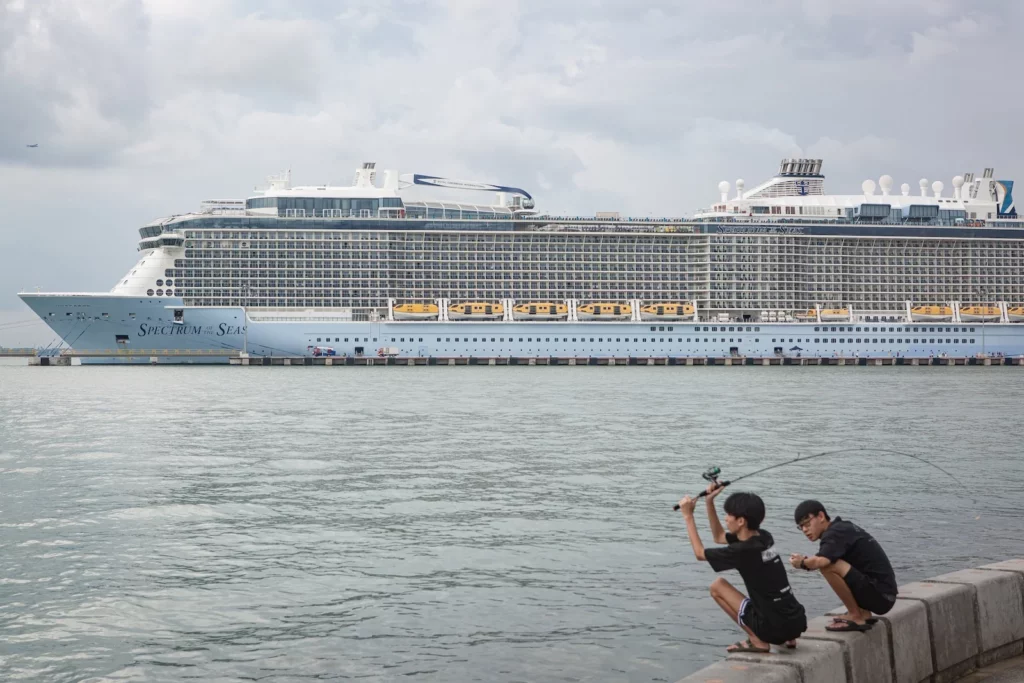
On a Friday afternoon in June 2023, two men fish near a cruise port on the Malaysian island of Penang. Docked at the pier was the China-based Spectrum of the Seas, a cruise liner built in 2019Royal Caribbean – Spectrum of the Seas celebrates inaugural season in china, 2019 and operated by American company Royal Caribbean across Asian routes. It was one of 156MMC Ports – Penang Records Rapid Increase in Cruise Tourism, 2024 international cruise ships that called at the port that year. The Swettenham Pier Cruise Terminal, with a depth of 11 metresPenang Port Commission – Swettenham Pier Cruise Terminal, can accommodate the world’s largest cruise vessels. Those floating hotels, designed for leisure travel, brought 573,000 visitors to Penang Island, increasing demand for accommodation, transport, and other tourism-related services.
The service sector, which accounts for nearly halfDepartment of Statistics Malaysia – Gross Domestic Product by State, 2022 of Penang’s economic output, is closely tied to the annual arrival of around three millionPenang State Exco for Tourism and Creative Economy – Penang Tourism Master Plan, 2021 international tourists. Its historic city, George Town, is a widely visited cultural destination that has been listed as a UNESCO World Heritage Site since 2008United Nations Educational, Scientific and Cultural Organization – From port city to World Heritage site. Long before tourism became its primary draw, Penang’s position on the Strait of Malacca made it one of Asia’s leading maritime centres from the 18th to the 20th century. Cultural exchanges between Asian, Arab and European sailors, among others, shaped hybrid communities such as the Peranakan, formed through marriages between local populations and descendants of migrants, often Southern Chinese settlers.
From wind to fossil fuels
First through trade, and now through tourism, Penang has been embedded in global maritime transportPort Albert Maritime Museum – How Ancient Asian Shipbuilders Shaped Global Exploration and mobility for centuries. It has witnessed successive generations of propulsion systems, from human-powered and wind-driven boats to coal-propelled vessels, then to oil and gas. But the maritime flows that sustain Penang’s economy are also linked to the pollution of its marine ecosystems. Cruise liners often run on high-sulphur fuel oil, a viscous residue from crude oil refining processes. The International Maritime Organisation restrictedInternational Maritime Organisation – IMO sulphur limit implementation, 2020 its use in 2020, yet permits continued use of the fuel on ships fitted with scrubber systems, which transfer captured pollutants into washwater that are often dumped into the ocean. The Strait of Malacca is estimated to receive the largestInternational Council on Clean Transportation – Global scrubber washwater discharges under IMO’s 2020 fuel sulfur limit, 2021 concentrations of such discharges in the world.
The two men fishing in Penang are part of Malaysia’s recreational angling community, estimated at more than 2.2 millionUniversiti Malaysia Terengganu Journal of Undergraduate Research – Current research theme on recreational fishing in Malaysia, 2024 people. The outdoor activity, a popular pastimeInternational Journal of Research and Innovation in Social Science – A Conceptual Framework for Profiling Stream Anglers in Malaysia, 2025 across Southeast Asia, also affectsProceedings of the National Academy of Sciences – Governing the recreational dimension of global fisheries, 2019 aquatic ecosystems through over-exploitation of fish stocks and the selective targetingPertanika Journals – Catch-and-release Behavior of Anglers in Tasik Muda, 2020 of species. Yet, the collapseWWF-Malaysia – No more fish to catch in our seas in 35 years?, 2012 of Malaysia’s marine fish populations in recent decades has largely been driven by commercial fishing. The country, home to nearly 12,000Food and Agriculture Organisation – Fishery and Aquaculture Malaysia Profile, 2012 fishing vessels longer than 12 metres, allowsThe Straits Times – How Malaysia’s looming fish trawling ban could affect your dining options, 2025 bottom trawling operations, one of the most destructive forms of fishing, in parts of its waters. This intenseGlobal Fishing Watch – GFW Map, 2026 fishing activity is primarily driven by domestic demand for seafood products, with per capita consumption among the highestOur World in Data – Yearly per capita supply of fish and seafood, 2023 globally, and tourism flows, including cruise passengers, adding to it.