
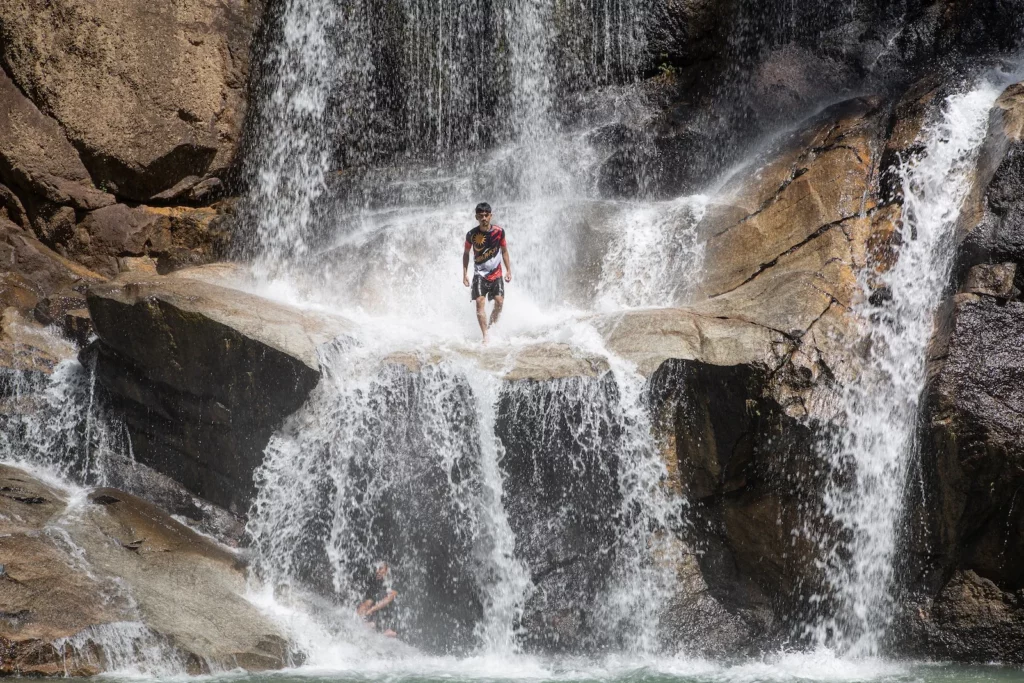
A Malaysian youth prepares to jump into the water at Sungai Pandan Waterfall in July 2023, in a forested area west of Kuantan on the South China SeaU.S. Energy Information Administration – South China Sea, 2024 coast. Malaysia’s Ministry of Tourism promotes the multi-tiered waterfall cascading across threeVisit Malaysia – Splashing in Sungai Pandan Waterfall levels as a destination for nature tourism and outdoor recreation. With more than 240Malaysia Tourism Promotion Board – Annual report, 2023 million domestic trips recorded in the Southeast Asian country in 2023, demand for local tourism is high. Visiting waterfalls, often combined with forest trekking or picnics, has long been a popularThe Sun Malaysia – Beware of headwater phenomenon while swimming in rivers, waterfalls, 2023 weekend activity among Malaysians.
Aquatic environments structure the landscape of Malaysia, a country with more than 2,900Global Environment Centre – RIVER Ranger programme 2.0, 2019 river basins. The tropical rainforest climateWorld Bank Climate Change Knowledge Portal – Malaysia, 2020, hot and humid year-round, results in annual rainfall exceeding 3,000World Bank – Climate risk country profile Malaysia, 2021 millimetres, the highestWorld Bank – Average precipitation in depth, 2022 level in Southeast Asia. In volumetric terms, this corresponds to nearly 1,000Water Environment Partnership in Asia – WEPA Database Malaysia, 2025 billion cubic metres of rainfall per year, equivalent to about 25 timesStanford University – Three Gorges Dam, 2022 the storage capacity of the largest human-made hydroelectric infrastructure, the Three Gorges Dam in China. More than half of this precipitation runs off, feeding river networks, waterfalls and lakes, and providing mostAcademy of Sciences Malaysia – Water sector transformation 2040, 2022 of Malaysia’s water supply.
Waterfall under siege
Yet, those flows of surface water are contaminated by pollutants produced by human activities. Malaysian authorities identified nearly 1.7 millionEcohydrology & Hydrobiology – Biomonitoring of Malaysian aquatic environments, 2017 discharge points of water pollution in the mid-2010s, and more than halfMalaysia Department of Environment – Environmental Quality Report, 2024 of the 672 rivers monitored in 2023 were classified as polluted or slightly polluted when tested for levels of ammoniacal nitrogenAlantech – Ammoniacal Nitrogen Removal From Water, 2025. This pollutant was not includedIIUM Engineering Journal – Sustainable river water quality management in Malaysia, 2013 as a monitoring parameter under Malaysia’s primary legislationMalaysia Department of Environment – Environmental Quality Act, 1974 for pollution control until it was amendedMalaysia Department of Environment – Environmental Quality (Industrial effluent) Regulations, 2009 in 2009.
Elevated concentrations of ammoniacal nitrogen in water are attributable to industrial effluents, sewage discharge and agricultural runoff. The latter includes leakages of nitrogen compounds from fossil fuel–derived fertilisers, which is toxicSchool of Civil Engineering Universiti Sains Malaysia – Water Quality Index, 2022 to aquatic organisms and causes excessive algae growth. Such pollution is a structural feature of the “high-input, high-output” paradigm that has shapedUnited Nations – The right to food, 2021 global agricultural systems following their industrialisation in the second half of the 20th century.
The road that leads to the Sungai Pandan Waterfall runs through oil palm plantations that have replaced a forest razed to monetise the land. The perennial tree crop, largelyMalaysian Palm Oil Council – Small farms the key to Malaysia’s palm oil sustainability, 2023 cultivated as industrial-scale monocultures, covered more than one-sixthUnited States Foreign Agricultural Service – Palm Oil, 2026Malaysia Biodiversity Information System – Malaysia Geographical of Malaysia’s total land area in the mid-2020s. The industry consumes an estimated sevenThe Malaysian Reserve – Hormuz fertiliser crisis threatens farms, 2026 to ten million tonnes of fertiliser annually, but a share of the applied nitrogen is not absorbedOil Palm Bulletin 72 – Oil palm fertiliser recommendation for Sabah soils, 2016 by oil palms. Instead, it leaks into the environment, polluting soils and waterways. Today, waterfalls where Malaysians swim, often promoted as sites of natural retreat, contain fertiliser residues traceable to the palm oil and fossil fuel industries.