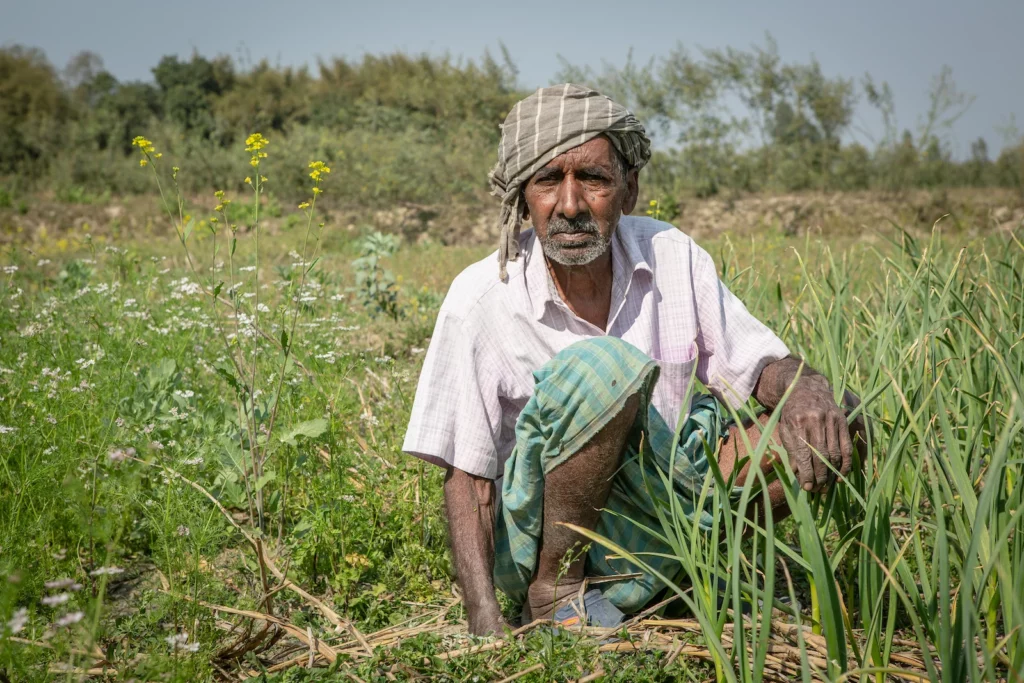
A Nepali farmer entrapped in a forced-labour system, locally known as haruwa-charuwa,International Labour Organization – Fighting bonded labour in Nepal, 2013 works in a field in the Terai region, a belt of flat land stretching along the Nepal-India border. Like hundreds of poor farmers in the Siraha district, he fell prey to a debt trap laid by a landlord belonging to the privileged castes. Nepal has prohibited such a system since 2002 after the Bonded Labour (Prohibition) ActMinistry of Home Affairs – Bonded Labour Prohibition Act 2058, 2002 declared “no one shall keep or employ anyone as a bonded labourer.” Yet the practice persists across parts of the landlocked Himalayan nation.
The situation in the Terai region sits within a broader transformation of Nepali agriculture, increasingly structured around smallholder farming that primarily grows cereal grains, legumes, and oilseeds. The average size of farmland more than halved over six decades, reaching about 0.5 hectareNational Statistics Office – National Sample Census of Agriculture Nepal, 2024 per holding by the early 2020s. This fragmentation stems from Nepal’s mountainous terrain, which constrains large-scale mechanised farming, a lack of capital to expand operations, and the subdivision of agricultural land among children during inheritance that has resulted in the progressive reduction of parcel sizes across generations.
‘Agricultural Investment Decade’
Nepal’s farms have often been deemed unproductiveWorld Bank – Sources of Growth in Agriculture for Poverty Reduction and Shared Prosperity, 2017 in light of the country’s ballooning importsWorld Trade Organization – World trade in agricultural products, 2024 of agricultural products and severe food insecurity still affecting roughly one in sixNational Planning Commission – Fill the Nutrient Gap, 2021 households in 2024. Yet, such perception reflects the limits of measuring productivity solely through yield per hectare, a metric that does not account for the externalities of chemical-intensive agriculture, such as loss of biodiversity or ecosystem services. An agriculture dominated by smallholders is associated with environmental benefits, like the use of traditional farming techniques that manage pests naturally and leverage crop rotation and the cultivation of multiple crops on the same parcel to enhance soil health. While limiting the use of fossil-fuel-intensive machinery, hedgerows and trees lining hillside farms in Nepal to hold soil on steep farmland have helped to maintain animal and plant diversity.
The Nepali government launched an ‘Agricultural Investment Decade’Radio Nepal – Budget declares Agriculture Investment Decade, 2024 in 2024 to accelerate flows of capital investments into the sector, including from the private sector, and “increase production and productivity”. Although from a low base by international standards, the use of fertilizer and pesticide already surged three-Our World in Data – Fertilizer use per hectare of cropland, 2025 and eleven-foldOur World in Data – Total pesticide use per area of cropland, 2025 respectively in the three decades leading to 2020, raising concerns over the risk of improper or excess use of agrochemicals. At stake is Nepal’s low-input smallholder farms as the country opens its agricultural sector to industrial investment, while farmers who are victims of forced-labour, like those trapped in the haruwa-charuwa system, hope renewed attention to the sector could help dismantle bonded labour systems.