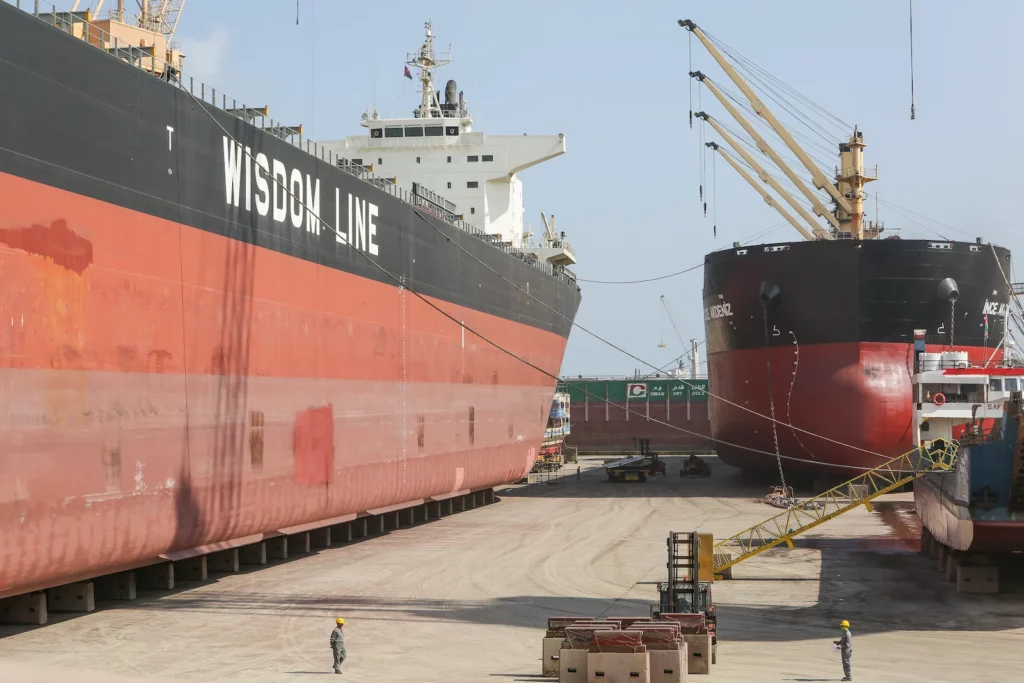
At the Port of Duqm, a ship repair and maintenance facility hosted two dry bulk carriers in November 2018. The vessel on the left, operated by the Taiwanese shipowner Wisdom Marine GroupWisdom Marine Group – About us to carry large quantities of raw materials across international shipping routes, is undergoing repainting. At the stern, workers in full protective suits perform abrasive blasting on the hull, removing old paint, rust, and attached marine organisms such as barnacles, mussels, and algae. The facility, located on Oman’s coastline on the Indian Ocean, has been operational since 2011Asyad – About Asyad Drydock and receives over 200 shipsAsyad – Asyad Drydock Accelerates Toward Global Maritime Leadership, 2025 annually.
The Omani dry dock is along a shipping corridor that carried 18 millionUnited Nations Trade and Development – Review of maritime transport, 2025 standard containers from East Asian factories to European consumer markets in 2024. It is part of a global network of maintenance sites that keep commercial ships in operation. That same year, the global merchant fleet comprised 110,000 vessels,United Nations Trade and Development – Merchant fleet by flag of registration and by type of ship, 2025 with Asia accounting for nearly half. On average, those ships have a service life of 20 to 30 years,United Nations Trade and Development – Review of maritime transport, 2025 with some running for a century.Lloyd's List Intelligence – The New Age of Old Ships, 2022
Leaking heavy metals
Routine repainting, typically carried out every three to fiveSeacoat – Why Marine Operators Are Switching to Non-Toxic Hull Coatings for Better Performance, 2025 years, is not cosmetic. Saltwater is highly corrosive and, if left unchecked, can degrade structural integrity, while marine organisms attached to the hull increase drag, slowing the vessel and raising fuel consumption. Globally, nearly 900 million litresEuropean Coatings – Floating towards slight growth, 2021 of marine coatings are applied to ships and offshore structures each year, including anti-corrosion and anti-fouling layers, with the latter intended to limit buildup. As these coatings wear, heavy metals they contain leach into the ocean. In addition, anti-fouling paints, still permitted across all shipping routes, incorporate toxic chemical substances that are gradually releasedNew Zealand Ministry for Primary Industries – Biosecurity and chemical contamination risks, 2013 into the water to kill marine organisms. Discharged by merchant vessels, these pollutants, whose composition has evolved over timeInternational Maritime Organization – Anti-fouling systems due to regulatory changes, sink through the water column and accumulate in seafloorAnalysis of Environmental Pollutants – Concentration of Organotin and Booster Biocides in Sediments of Seagrass Area from Sungai Pulai Estuary, 2019 sediments and marine life, such as crabs, shrimps, and mollusks.
While anti-fouling paints containing chemical additives remain the most widely usedMordor Intelligence – Marine Coatings Market Size & Share Analysis, 2021 coating across merchant fleets, alternatives that do not rely on harmful substances exist but come at higher cost. Among them is silicon-based coatings that create a slippery surface that prevents marine organisms from attaching easily. In 2023, Duqm reportedly became the first West Asian dry dock to apply a silicone coatingAsyad – Asyad Drydock shows off its advanced capabilities by successfully applying new eco-friendly nano-epoxy silicone coating, 2023 described as “eco-friendly” on a bulk carrier. Yet, like other marine coatings that frequently contain large amounts of plastic-based materials, the silicon coating applied in Oman also included nano-epoxy, a type of plastic. As vessels sail, fragments of these coatingsMarine Pollution Bulletin – Paint fragments as polluting microplastics, 2020 break off and enter the water as tiny plastic particles,Environmental Sciences Europe – Unravelling microplastics from marine coatings through bibliometrics science mapping in thematic analysis and systematic narrative literature review, 2025 shown to impair the growth of phytoplankton,Mongabay – Microplastics pose risk to ocean plankton, 2023 the base of the aquatic food web.