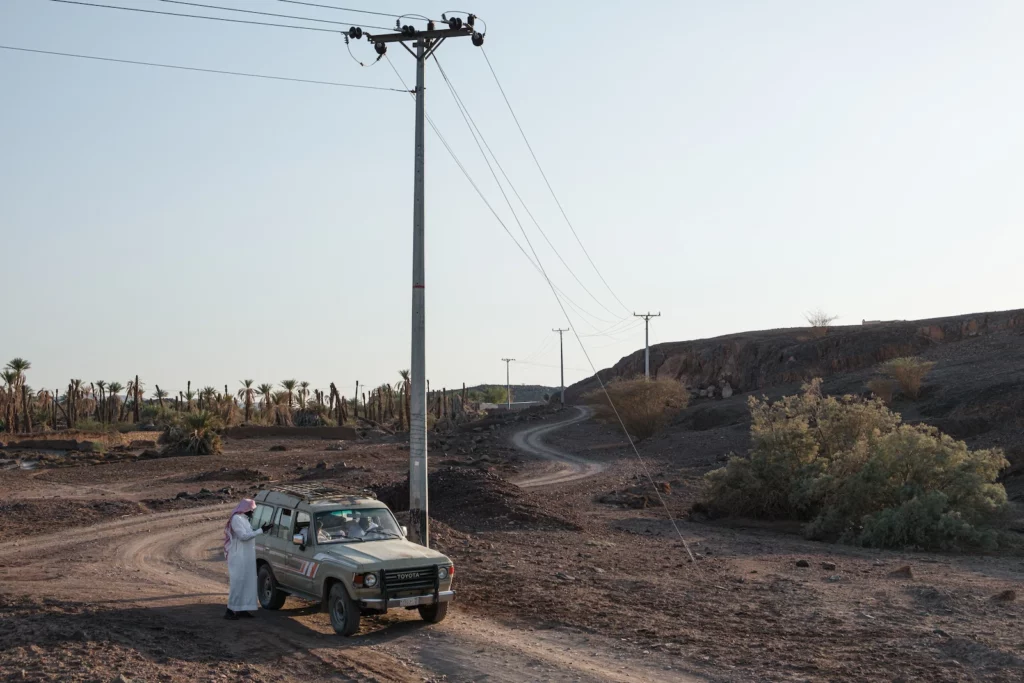
Along an unpaved road in the oasis of Khaybar in northwestern Saudi Arabia, three men attired in the traditional male clothing pause to talk. Hundreds of thousandsUnited States Geological Survey – Refined chronology of late Quaternary eruptions at Harrat Khaybar, 2025 of years of volcanic activity in the region have shaped the surrounding landscape, leaving it dotted with dark volcanic rocks.NASA – Harrat Khaybar Volcanic Field, 2008 The area has experienced extensive flows of lava,Oregon State University – Harrat Khaybar Volcanic Field, 1993 a substance among the hottest naturally found at Earth’s surface and a manifestation of geothermal energyVattenfall – Volcano power unleashed with the help of AI, 2025 contained in the planet’s crust. Power lines run above the men, carrying electricity generated in power plants that burn fossil fuels, another powerful form of energy present in the subsurface.
Despite having one of the world’s highest solar power potentials,Global Solar Atlas – Global Photovoltaic Power Potential by Country, 2020 Saudi Arabia still produces roughly 99%International Energy Agency – Saudi Arabia, 2023 of its electricity by burning gas, crude oil, and heavy fuel oil, a viscous residue from crude oil refining processes. Saudi Arabia burned 400 millionU.S. Energy Information Administration – Saudi Arabia, 2024 barrels of oil in 2023 to produce electricity. As a result, the West Asian kingdom ranks among the 20 countriesOur World in Data – Lifecycle carbon intensity of electricity, 2026 with the highest emissions of Earth-warming gases per kilowatt-hour generated. The Saudi political leadership has committed to source half its electricityKing Abdullah Petroleum Studies and Research Center – Geospatial Dashboard for Renewable Projects in Saudi Arabia, 2026 from renewables by 2030, yet solar and wind power represented less than 5%Ember – Electricity Data Explorer, 2024 of that target as of 2024.
Disinhibited consumption
Saudi Arabia’s hot desert climate,Climate Change Knowledge Portal – Saudi Arabia country overview, 2020 like the one seen in Khaybar, has driven inhabitants to bunkerise themselves in temperature-controlled interiors. “With the summer heat, you cannot live without air conditioning, it is impossible,” said Amal al-Qarini, a Saudi woman working in the philanthropic sector in Riyadh. Air conditioning is estimated to account for more than halfKing Abdullah Petroleum Studies and Research Center – A Potential Solution for Saudi Arabia’s Building Sector, 2025 of the electricity used in the building sector, making Saudi Arabia one of the world’s largest consumersOur World in Data – Total electricity demand per person, 2026 of electricity per person. Part of this demand stems from low-efficiency appliancesJournal of Building Engineering – Transitioning to high efficiency air conditioning in Saudi Arabia, 2020 and air-conditioning systems, along with poorly insulated buildings. “We are aware that we need to change our habits,” acknowledged al-Qarini. Yet, more than four in tenGeneral Authority for Statistics – Household Energy Statistics, 2022 households are unwilling to pay for more energy-efficient appliances, and nearly four in five show no interest in using solar energy in their place of residence.
The increase by two-thirdsInternational Energy Agency – Saudi Arabia Electricity, 2023 of electricity consumption per capita in Saudi Arabia over the first two decades of the 21st century is the result of decades of government subsidies that have sold kilowatt-hours to households below their production cost. This subsidy cultureInternational Energy Agency – Fossil Fuel Subsidies Database, 2025 has also insulated the population from the long-term environmental and climatic implications of fossil fuel-generated electricity and the feedback loop it has entrenched the country in. Like other Saudis, the men in Khaybar are exposed to the prospect of increasing summer heatIPCC WGI Interactive Atlas: Regional information driven by global warming, to which the burning of billions of barrels of oil for electricity over decades has contributed.