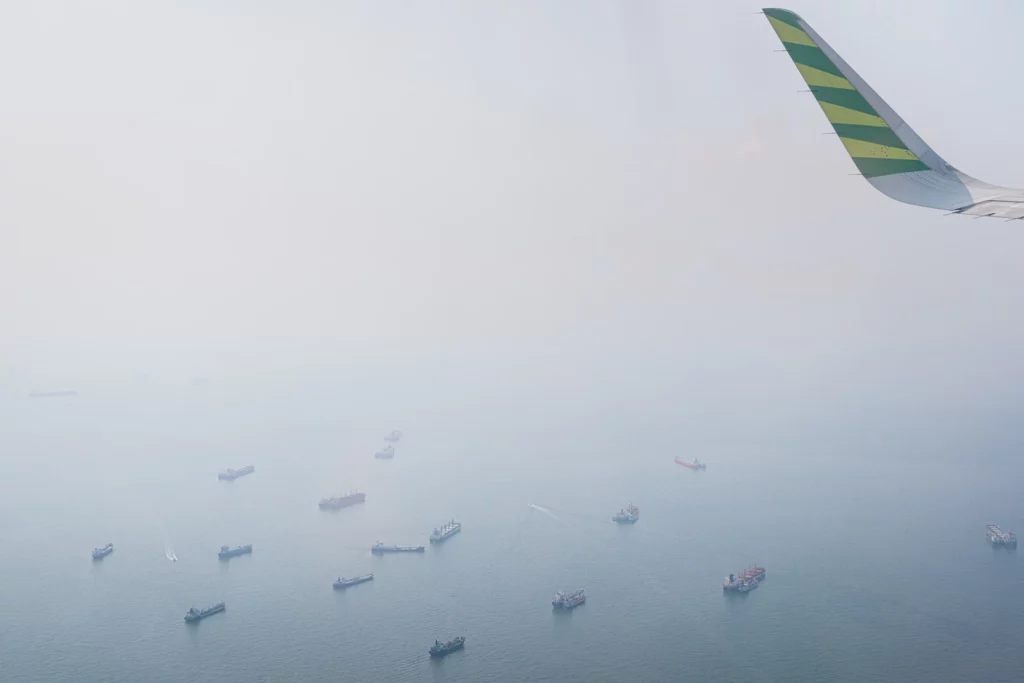
For centuries, Singapore has held a position in Asia’s trading networks, alternately rising and fadingNational University of Singapore – A Very Short History from Temasek to Tomorrow, 2021 in prominence. Known in earlier periods as Pu Luo Chung,Singapore Ministry of Culture – Singapore, 1991 Long Ya Men,Singapore Ministry of Foreign Affairs – Official Launch of the Singapore Zheng He 600th Anniversary Celebrations, 2005 Temasek,National Heritage Board – Singapore archaeology, 2017 and Singapura,National Library Board – Temasek/Singapura, 2014 the island functioned as a trade outpost for sailors moving between the South China Sea, the Indian Ocean and the Persian Gulf. Viewed from above, the waters off Singapore are nowadays dotted with commercial vessels. At any given time, hundreds of container ships, bulk carriers and fossil fuel tankers are anchored there as more than 80,000 vesselsCNA – More ‘shadow fleet’ vessels carrying sanctioned cargo spotted in waters off Singapore, 2025 transit through the 113-kilometre-longNational Library Board – Singapore Strait, 2015 Singapore Strait annually. The shipping corridor functions as a conduit between West Asia’s oil and gas fields and East Asia’s factory floor, where this energy powers factories producing goods for consumer markets.
Roughly 30%U.S. Energy Information Administration – World Oil Transit Chokepoints, 2026 of all crude oil and petroleum products transported by sea globally transit through the narrow waterway. Yet Singapore does more than channel those energy flows; it has become a key node in the global maritime supply chain. The Asian city-state is the world’s largest supplier of marine fuels that propel shipping fleets, with sales totaling a record high of 57 million tonnesMaritime & Port Authority of Singapore – Maritime Performance, 2026 in 2025. Businesses involved in refuelling vesselsMaritime & Port Authority of Singapore – List of top 10 bunker suppliers, 2025 include oil companies such as BP, PetroChina, and Sinopec, along with commodity traders like Vitol.
Heavy metals mixed with seawater
The types of marine fuel supplied through Singapore’s infrastructure reveal a shift in the energy used by vessels. The share of high-sulphur fuel oil in the city-state’s sales fell from 95% a decade earlier to 38%Maritime & Port Authority of Singapore – Maritime Performance, 2026 in 2025. The fuel, a viscous residueThe Angry Clean Energy Guy – Episode 60, 2022 from crude oil refining processes with sulphur accounting for up to 3.5% of its total weight, has come under tightening regulatory limits. A global regulation introduced by the International Maritime Organization in 2020 banned the use of marine fuels with a sulphur content above 0.5%.International Maritime Organization – IMO 2020 sulphur limit implementation, 2020 As a result, Singapore’s sales of fuels with lowered sulphur content, known as low sulphur marine gas oil (LSMGO) and low sulphur fuel oil (LSFO), have surged more than fortyfoldMaritime & Port Authority of Singapore – Maritime Performance, 2026 between 2015 and 2025.
Yet, the International Maritime Organization introduced a loophole that allows ships to keep burning high-sulphur fuel oil, if fitted with a device known as a scrubber to clean exhaust gases.International Maritime Organization – 2015 Guidelines for exhaust gas cleaning systems, 2015 It captures pollutants previously released into the atmosphere, including sulphur and heavy metals, and mixes them with seawater, which in most ships is dumped into the ocean. It is estimated that global commercial shipping releases at least ten billion tonnesInternational Council on Clean Transportation – Global scrubber washwater discharges under IMO’s 2020, 2021 of scrubber washwater each year, effectively transferring its environmental impact from atmospheric pollution and acid rain to the degradation of marine ecosystemsNew Zealand Ministry for the Environment – Risks from Discharges from Exhaust Gas Cleaning, 2020 and ocean acidification.
Singapore has sought to shield its coastal waters from this form of pollution by classifying washwater as “toxic industrial waste”Maritime & Port Authority of Singapore – A Guide For Ships Calling To Port Of Singapore, 2018 and prohibiting its discharge in its ports. The thousands of vessels that transit the Singapore Strait, however, face no such restrictions, and Singapore’s waters contain an estimated 15,000 tonnesInternational Council on Clean Transportation – Global scrubber washwater discharges under IMO’s 2020 fuel sulfur limit, 2021 of washwater per square kilometer, the highest concentration in the world. Some of the pollutants contained in marine fuels sold in Singapore to global shipping fleets ultimately return to its waters, carried back through the same trade routes that have defined the island’s role in Asian maritime networks for centuries.