
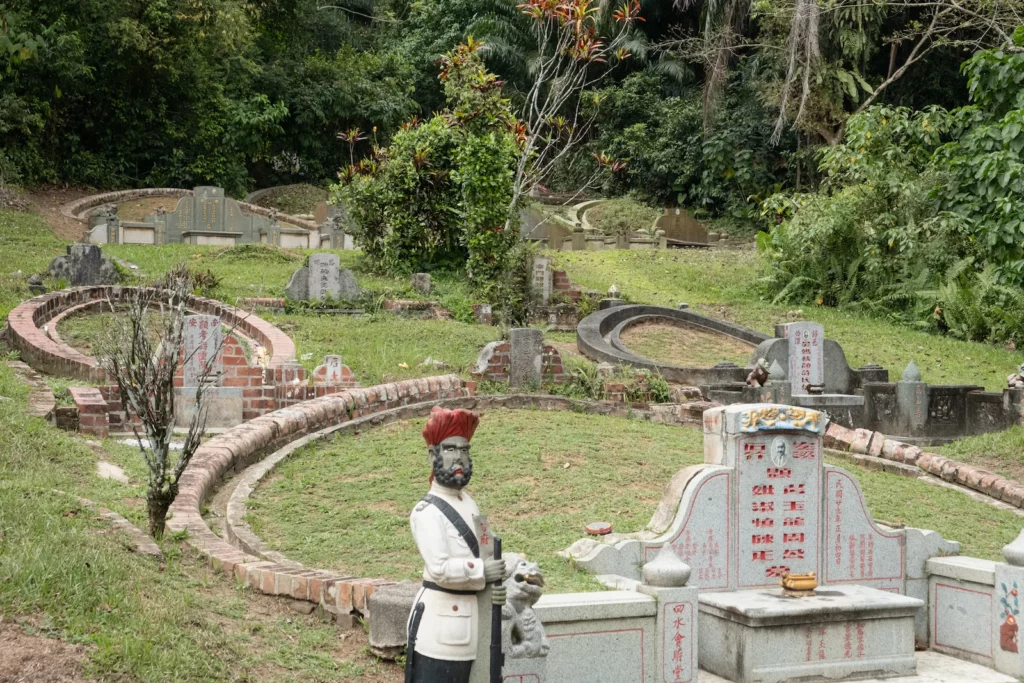
In a red turban, a Sikh guard statueHeritage Singapore – Bukit Brown Cemetery – The “Live” Tomb keeps vigil at the tomb of Chew Geok Leong, a Chinese physician who died in 1940 in Singapore, where he had settled several decades earlier. The belief that Sikh guardsThe Straits Times – Sikh guards at Chinese tombs 'show there were strong links', 1993 protected Chinese communities in the afterlife mirrored their roleSingapore Police Force – The Legacy of the Sikh Contingent, 2024 in Singapore at the time. Originating from India’s Punjab, they were widely employed as watchmen, security officers, and personal bodyguardsSingapore National Library – Night jaga, 2017 of wealthy Chinese. Leong’s tomb is one of more than 30Heritage Singapore – Bukit Brown Cemetery – Bukit Brown Wayfinde still standing at Bukit Brown Cemetery, which served Singapore’s Chinese community for half a century until it closed for burial in 1973 with an estimated 100,000Singapore National Library – Bukit Brown Municipal Cemetery, 2013 interments.
Singapore has historically attracted migrants from across Asia, drawn by its emergence as a major maritime hub at the confluence of trade routes. Chew Geok Leong was among the large numberSingapore National Library – Chinese coolies, 2016 of Chinese who migrated to Singapore from the 1820s to the 1920s, and their community reached 700,000Singapore National Library – First post-war census begins, 2014 by the mid-20th century. The Southeast Asian island’s population expanded further, triplingSingapore Department of Statistics – Indicators On Population, 2025 in the five decades following its 1965 independence. It crossed the six million mark for the first time in 2024, with nearly three-quartersSingapore Department of Statistics – Population Trends, 2025 of inhabitants of Chinese ethnic origin.
Tombs, highways and housing
The same waves of migration, however, have made land the scarcest resource in Singapore. Although coastal land reclamation has extended the city-state’s land area by more than a quarterSingapore Department of Statistics – Total Land Area of Singapore, 2024 since its independence, population growth outpaced territorial expansion. Today, Singapore is one of the most densely populated countries in the world, with more than 8,500United Nations Data Portal – Population density, 2026 people per square kilometer. As the past competes with the present for the same finite land, Bukit Brown Cemetery, a testamentChina Daily – Cemetery is of iconic significance in Singapore, 2021 to Singapore’s 20th-century Chinese heritage, is being absorbed into the country’s 21st-century urban fabric.
“Bukit Brown is needed in the future for housing,” a Singaporean official wroteSingapore Urban Redevelopment Authority – Why Bukit Brown is needed for housing, 2011 in 2011. Seven years later, the Lornie Highway,Singapore Land Transport Authority – Opening of Lornie Highway Northbound, 2019 built over parts of the cemetery, opened to motorists after more than 4,150The Straits Times – New outdoor display at Bukit Brown Cemetery to open by August, 2024 graves were exhumed. The loss could extend beyond heritage. Nearly a thirdeBird – Bukit Brown Cemetery, 2026 of the 450eBird – Singapore, 2026 bird species found in Singapore have been observed by bird enthusiasts at the cemetery, ornithological app eBird shows. But ecological losses predate population pressures. In the eight decades following their arrival in Singapore in 1819,Singapore National Library – Singapore History British colonial authorities wiped out more than 90%Singapore National Environment Agency – Transforming Singapore into a city in nature, 2021 of the primary forest area, mainly to expand plantation agriculture.
Since its independence, Singapore has sought to reverse the trend, incorporating vegetation into the urban fabric through a government-led programme. In seeking equilibrium between natural ecosystems and human infrastructure, the afterlife has not been exempted. Land scarcity led to a 1998Singapore National Environment Agency – Burial, Cremation and Ash Management regulation limiting the burial period to 15 years, after which the grave would be exhumed, unless religious prohibition applies. As of the early 2020s, eightSingapore National Environment Agency – Post-Death Matters, 2026 out of ten people who died in Singapore were cremated. The few remaining tombs at Bukit Brown Cemetery are among the last traces of a history that land scarcity has already erased elsewhere.