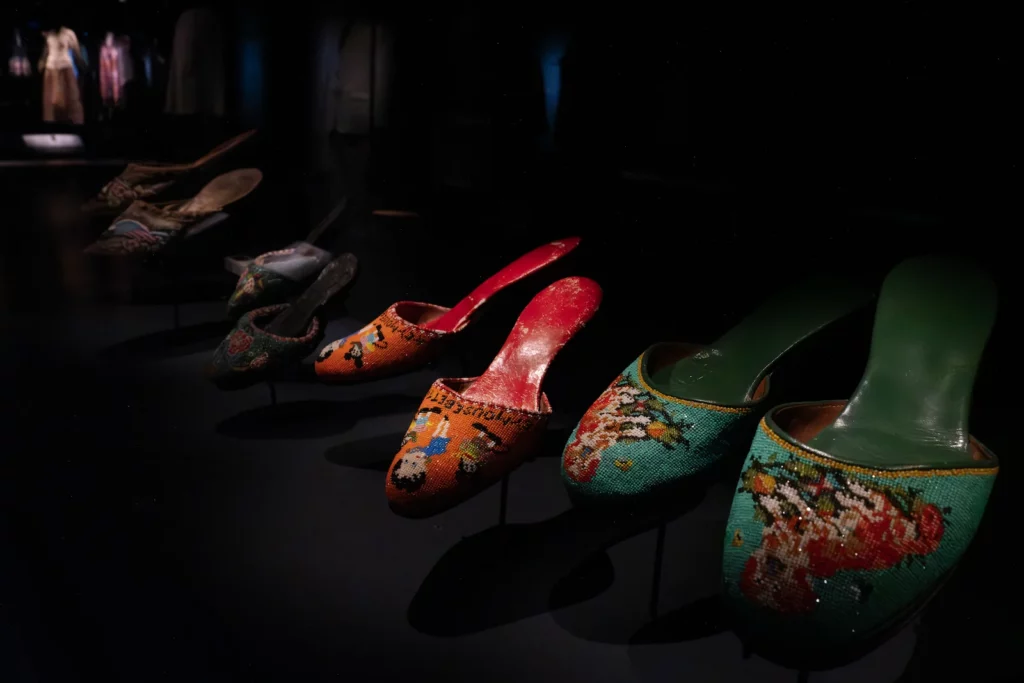
In a darkened museum room in Singapore, a pair of orange heeled slippers stands out under focused display lighting. The shoes were reportedly made in the Southeast Asian port city in the early 1930s. Singapore’s location at the confluence of major Asian maritime trading routes contributed to the emergence of a cosmopolitan fashion sceneSingapore Fashion Histories that blended styles from the Malay-Indonesian world with Chinese, Indian, Arab and Western influences. For centuries, clothes makers used a wide range of materials, including Chinese silks and Indian gold threads, while drawing inspiration from imported books and magazines for designs, motifs and adornments.
Such hand-stitched beaded shoes, known as kasut manikPenang – Stepping into the World of the Peranakans in Malay, gained prominence within Peranakan communities during that decade. The term designates multicultural groupsPeranakan Museum – Origins and stories of the Peranakan communities formed through marriages between local populations and descendants of migrants, often Southern Chinese settlers. Their hybrid cultureSingapore National Library – Peranakan (Straits Chinese) community, 2013 birthed Peranakan fashion, a fusion of external clothing influences with local Southeast Asian styles. One of its defining elements is a tightly fitted version of a blouseThe Straits Times – Beautiful, versatile Kebaya, 2024 worn with a long batik skirt, known as sarong kebaya. The women’s embroideredUnited Nations Educational, Scientific and Cultural Organization – List of the Intangible Cultural Heritage of Humanity, 2024 attire remains part of contemporary dress in Singapore, including as uniforms for the country’s national airline. Yet, Peranakan fashion has gradually fallen out of everyday use, and became limited to attire mainly reserved for special occasions.
Worn once, then discarded
By the 1960s, most members of Peranakan communities had already “switched to modern Western fashions, reflecting the global appeal of Western popular culture,” one of the didactic panels at Peranakan Museum reads. The pair of orange slippers offers a historical record of Singapore’s early move towards Westernised clothing by featuring Mickey Mouse. Over the following decades, the American cartoon character, who made his debut in Hollywood in 1928,Walt Disney Family Museum – The Birth of a Mouse, 2012 became a globally recognised cultural icon, and served, along with Disney-branded consumer goods, as a commercial symbolThe French Journal of Media Studies – Showcasing American Capitalism in Disney Theme Parks, 2018 of American-style capitalism and consumerism. The growing prominence of Mickey Mouse in popular culture worldwide coincided with a shift towards plastic fabrics following the invention in 1935London Science Museum – The creation of a revolutionary fabric, 2018 of nylon, the first fully synthetic fibre.
Today, fast fashion has become a defining feature of clothing purchases in the island nation. Singaporeans bought an average of 34 piecesSingapore National Library – Fast fashion, 2022 of new clothes per year in 2016, while discarding 27, and a thirdYouGov – A third of Singaporeans have thrown away clothing after wearing it just once, 2017 acknowledged having thrown away a garment after wearing it just once. One commonly cited reason was “making space for new clothes”. This scale of consumption supports an industry whose supply chain is among the most polluting globally, producing wastewater containing a cocktail of chemicals, and mounds of waste that release microplastics into the environment. Singapore generated over 200,000 tonnesSingapore National Environment Agency – CY2024 vs CY2023 Waste Statistics and Overall Recycling Rate, 2025 of textile and leather waste in 2024, with less than one in thirty recycled. Shoes displayed at the Peranakan Museum bear witness to a time before synthetic fibres, when clothing took weeks to produce and was intended to last.