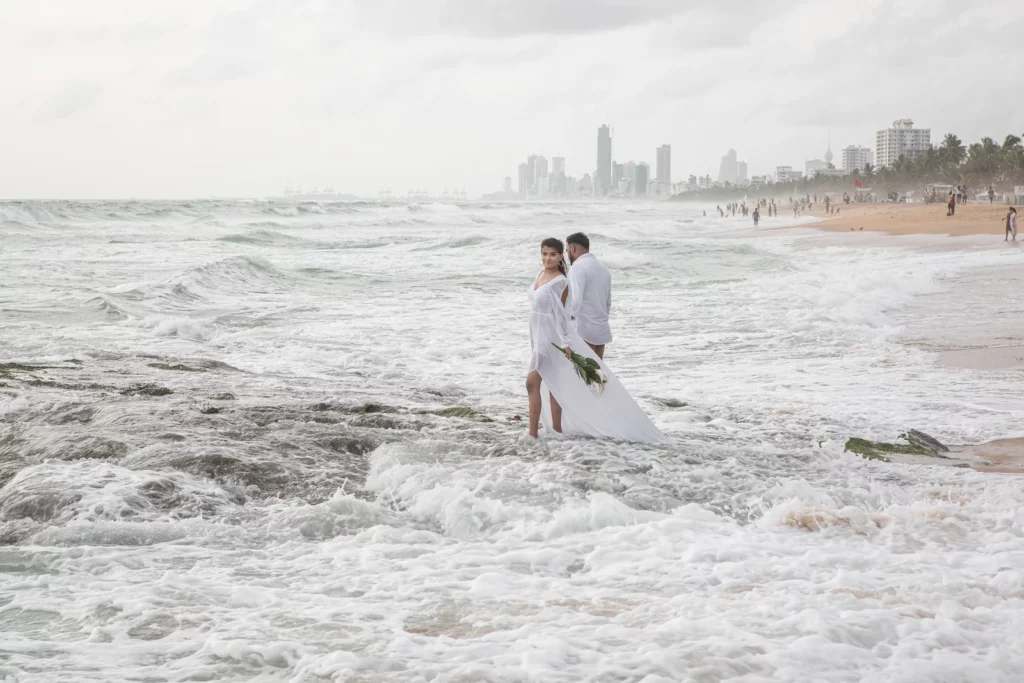
Two newly-wed Sri Lankans pose in the waves for their wedding portrait in Dehiwala-Mount Lavinia, a touristic seafront district south of Colombo, the country’s capital city. The shooting took place in June 2022 amid the economic and political crisis that ended the grip of the Rajapaksa family on the South Asian island. That breakdown, rooted in macroeconomic vulnerabilities, unsustainable budget deficits, and policy missteps, left the government unable to shoulder the cost of oil imports and revealed Sri Lanka’s high dependence on imported fossil fuels. Yet, the turmoil did not deter couples from tying the knot. More than 170,000Sri Lanka Department of Census and Statistics – Number of Births, Deaths and Marriages registered by District, 2023 unions were recorded that year, five percent higher than the year prior.
Beyond the immediate pressure of a crisis that brought fossil-fuel-powered mobility to a standstill and halted livelihood, Sri Lanka is exposed to a deeper structural vulnerability. The same seawater soaking the bride’s white dress is projected to encroach further inland. Sea level rose by half a centimetreUnited States Earth Information Center – Sea level explorer Sri Lanka, 2024 per year in the early 2020s, more than six times the rate observed in the 1980s. As the climate warms due to human activity, primarily the combustion of fossil fuels, the melting of ice sheets and glaciers accounts for halfWorld Bank Climate Change Knowledge Portal – Sri Lanka, 2025 of sea level rise in Sri Lanka. Meanwhile, higher temperatures cause seawater to occupy more volumeNASA Sea Level Change Portal – Understanding Sea Level as it absorbs heat, a natural phenomenon known as thermal expansion.
MV X-Press Pearl’s toxic legacy
A higher sea level carries direct consequences for Sri Lanka by driving saltwater farther inland. “Increased salt water intrusion will change the quality of irrigation waters and soils leading to loss of arable land and agricultural production,” a Sri Lankan official warned in 1990Ministry of Environment of Sri Lanka – Sri Lanka and Sea Level Rise, 1990. Still, the country’s exposure to sea level rise is structurally disconnected from its own contribution to global warming. The carbon dioxide (CO2) accumulated in the atmosphere was released by others, including Asia’s largest economies. Sri Lanka is responsible for less than 400 gramsOur World in Data – Who has contributed most to global CO2 emissions, 2019 per tonne of CO2 that has been emitted globally by human activities since the mid-18th century. Though historically marginal, its emissions of Earth-warming gases have increased, more than doubling over three decades to reach 36 millionThe Emissions Database for Global Atmospheric Research – GHG emissions of all world countries, 2025 tonnes by 2020.
Waves at the couple’s feet in Dehiwala-Mount Lavinia had already brought a more immediate environmental cost of fossil fuels to the shoreline. Sri Lanka grappled in 2021 with the largestThe Guardian – The worst toxic waste you’ve probably never heard of, 2021 marine plastic spill ever recorded after a Singapore-registered containership bound for Colombo with 1,486 containers onboard caught fire and sank 18 kilometres north of the capital city. The MV X-Press Pearl’s cargo spilled an estimated 70–75 billionSupreme Court of Sri Lanka – SC/FR Application No. 168/2021, 2021 plastic pellets derived from fossil fuels into Sri Lankan waters, which then blanketed coastal mangroves and beaches. The spill was a headline-grabbing instance of a larger, continuous flow of plastics into marine environments. Most of Sri Lanka’s plastic waste remains mismanaged, and several tonnesMinistry of Environment of Sri Lanka – National Action Plan on Plastic Waste Management, 2021 leak each day into waterways and beaches along the Indian Ocean, where daily activities and ceremonies continue.