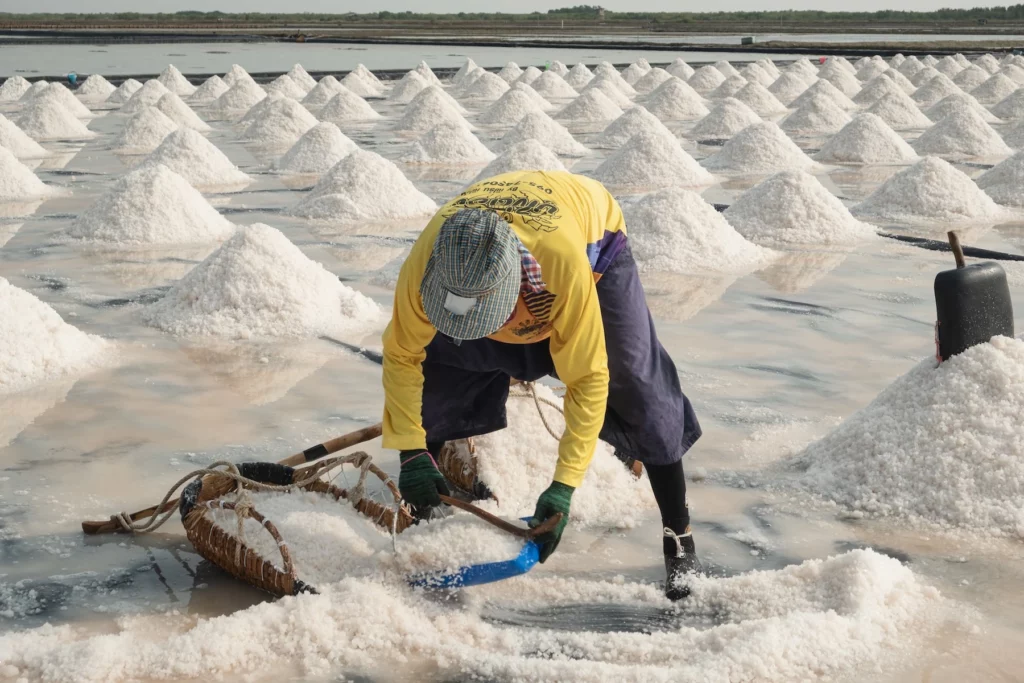
On an early morning in May 2026, a Thai worker harvests sea salt at a farm in Phetchaburi, a coastal province on the Gulf of Thailand. He is covered from head to toe to shield himself from the corrosive mineral and the harsh glare reflected by the white crust of salt crystals left behind after weeks of seawater evaporation. The labour-intensive work, including carrying salt in woven baskets, has been handed down from generation to generation since a royal initiative trialled the practice in Phetchaburi in the early 15thSustainability – Cultural Capital of Sea Salt Farming in Ban Laem District of Phetchaburi Province as per the Globally Important Agricultural Heritage Systems, 2023 century during the Ayutthaya EraRoyal Thai Embassy in Vienna – Thailand's History. But the agricultural heritage has far older roots, with ancient writings tracing salt production to China roughly five millenniaSalt Association – Salt During Our Early History ago during the final stage of the Neolithic period.
Today, Phetchaburi remains the heartland of Thailand’s sea salt industry, along with two other provinces on the Gulf of Thailand. Around 200 salt farms operate across the region, with an estimated combined annual capacity of 160,000United States Geological Survey – 2020–2021 Minerals Yearbook, 2024 tonnes. In addition to coastal evaporation ponds designed to harvest the roughly 30 grammesChulalongkorn University – Gulf of Thailand, 2019 of salt contained in each litre of Gulf of Thailand seawater, the country is home to Southeast Asia’s largest rock saltPimai Salt Company Limited – Introduction Pimai Salt Company Limited mine, which can produce an additional 1.7Thai Refined Salt Company – About TRS million tonnes per year. The production is largely for domestic consumption, with exports standing at 250,000World Integrated Trade Solution – Thailand Salt and pure sodium chloride; sea water exports, 2024 tonnes in 2024, mostly to Asian markets.
Salt in the battery age
Although Thai diets containing 80%The Nation – 88% of Thais exceed daily sodium intake, 2026 more sodium than levels recommended by the World Health Organization contribute to demand, the bulkEuropean Salt Producers' Association – Nutrition, 2026 of global salt production goes toward deicing and industrial supply chains, with about 14,000South Australia Department for Energy and Mining – Salt direct and indirect uses identified. Caustic soda and chlorine producedAGC Vinythai – Annual report, 2023 from salt are essential inputs into the textile and leather, pharmaceutical, detergent, metal, chemical, plastics, and paper industries, among others. The rapid riseInternational Energy Agency – Global Energy Review, 2026 in demand for electricity storage in the transport and energy sectors, including sodium-ion batteriesMaterials for Renewable and Sustainable Energy – Sodium-ion battery from sea salt, 2022, is projected to increase consumption of salt derivativesInternational Renewable Energy Agency – Sodium-ion batteries, 2025. Chinese manufacturer CATL said it achieved mass production of sodium-ion batteries “for the first time” in 2025CATL – Naxtra Battery Breakthrough & Dual-Power Architectures, 2025.
Sea salt is dubbedUnited States Geological Survey – Mineral Commodity Summaries, 2026 the “virtually inexhaustible” resource as salt contained in ocean waters is “nearly unlimited”. Yet, its extraction from the natural environment in Phetchaburi occurs in evaporation ponds built over centuries on coastal wetlands and mangrove forests. About 83%United Nations Development Programme – Blue Carbon Society and UNDP team up on a ‘masterplan’ for Phetchaburi’s mangroves and its coastal ecosystems, 2019 of the province’s mangroves have been affected by human activities, weakening natural defences against coastal erosionMahidol University – Evolution of Mangrove Muddy Coast in the Western Coast of the Upper Gulf of Thailand Over the Past Six Decades, 2020. Human-made salterns, however, now functionThailand Office of Natural Resources and Environmental Policy and Planning – Guidelines of Habitat management for Migratory Waterbirds, 2025 as a partial substitute for wetland habitat. The coast along Thailand’s sea salt belt, listedKey Biodiversity Areas – Inner Gulf of Thailand, 2012 as a Key Biodiversity Area, hosts 150,000 to 300,000 birds annually, including endangered species.
Meanwhile, the consumerist society that salt contributed shaping through its role in global production systems has found its way back to Phetchaburi farms. Mixed with the sea salt farmers harvest are residues of the throwaway culture now present in seawater across the globe. Over 90%Greenpeace – Over 90% of sampled salt brands globally found to contain microplastics, 2018 of table salt brands sampled worldwide in the late 2010s contained microplastics, with Thai sea salt showing one of the highestEnvironmental Science and Technology – Global Pattern of Microplastics (MPs) in Commercial Food-grad Salts, 2018 levels of microplastic contamination.