
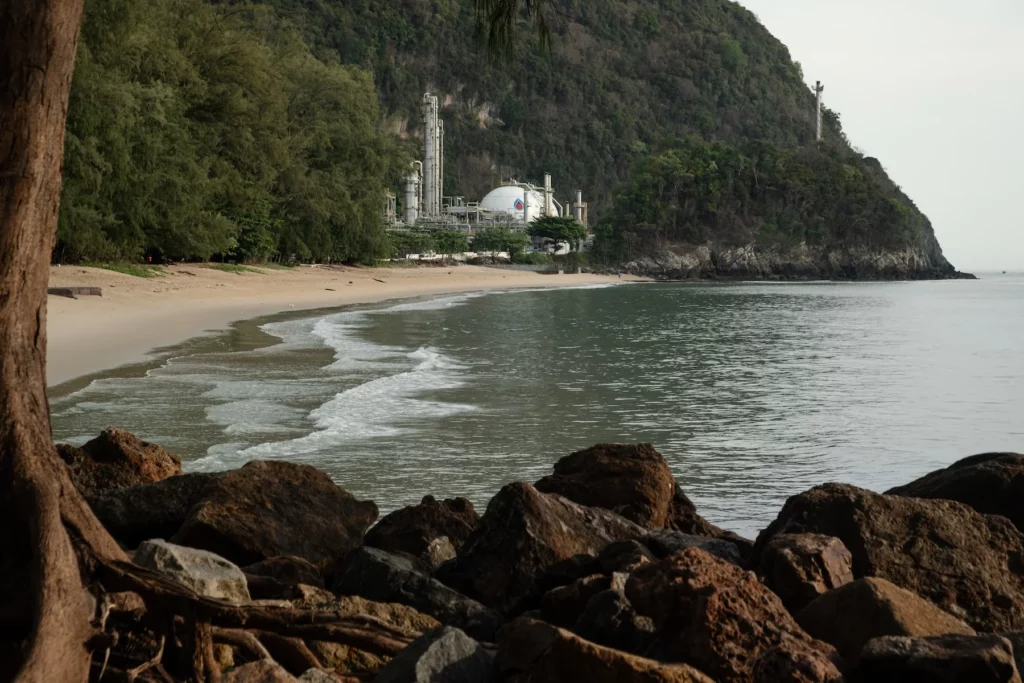
A Southeast Asian seashore dubbed the ‘Power Plant Beach’ offers the unusual juxtaposition of an electricity generating station and the Gulf of Thailand’s coastline. On weekends, families picnic, swim and watch the sunset under the gaze of the Khanom Power Plant, the largestEGCO Group – Our History in the country’s Southern region. Constructed in multiple phases between 1979 and 2016, the plant has burnt primarily domestically producedThailand Energy Policy & Planning Office – Natural Gas Production, Consumption and Import, 2026 gas for decades to power livelihood and economic activity. At times of gas supply shortages, it runsEGCO Group – Khanom Power Plant Unit 4 on diesel oil.
Thailand primarily relies on gas to power its national grid, with the fossil fuel accounting for about two-thirdsEmber Energy – Thailand electricity generation, 2025 of electricity generation. Yet, a sharp increaseEmber Energy – Thailand electricity demand, 2025 in electricity consumption in recent decades has placed excessive pressure on domestic reserves, depletingAsia Pacific Energy Research Centre – Gas Report, 2024 some fields, and pushingWorld Integrated Trade Solution – Thailand Natural gas imports by country, 2023 Thailand towards increasing dependence on gas imports to keep its fleet of power plants running. The country is now the largestWorld Integrated Trade Solution – Natural gas imports by country, 2024 importer of liquefied natural gas in Southeast Asia, and additional gas infrastructure is underway. It plans to open its third LNG import terminal at Map Ta Phut Port in 2029Nikkei – Thai company to build $2bn LNG terminal as energy deficit looms, 2025 in anticipation of the projected rise of imports of the liquefied fuel by 75%Institute for Energy Economics and Financial Analysis – Thailand’s gas fleet faces dual challenge of rising costs and underutilization, 2026 by 2037, further cementing the role of imported gas in the energy mix.
Heated water
The combustion of gas for power is far from climate-neutral, with a global average of 0.4 and 0.6Intergovernmental Panel on Climate Change – Technology-specific Cost and Performance Parameters, 2018 kilograms of Earth-warming gases emitted for each kilowatt-hour generated. Beyond its well-documented impact on the atmosphere, electricity generation has another yet less visible environmental footprint, hinted at by the Khanom Power Plant’s immediate proximity to the Gulf of Thailand. The activity guzzles vast amounts of water. EGCO Group, a Thai energy utility company that owns the facility, withdrew 3.9 billionEGCO Group – Performance Data, 2024 cubic metres of water from lakes, rivers, canals and the sea in 2023 for use across its global fleetEGCO Group – Minutes of Shareholders’ 2025 Annual General Meeting, 2025 of power plants. The water intake process often killsU.S. Environmental Protection Agency – Human Health & Environmental Impacts of the Electric Power Sector, 2025 aquatic life it pulls into the plant’s systems. Most of this water is then discharged back into the environment after it has cooled machinery and produced steam in combined cycle power plants, where waste heat generates steam that drives a second turbine.
Discharges by Thailand’s network of over 100Global Energy Monitor – Global Oil and Gas Plant Tracker, 2026 gas fired-power plants are not pollution-free; they often contain traces of heavy metals and chemicals. The temperature of such discharged waters, limited at 40 degreesICS Thailand – Thailand Industrial Cooling Compliance Guide, 2025 Celsius in Thailand by governmental regulations, is often higherClean Air Task Force – The Hidden Side of Power Plant Pollution, 2004 than the water bodies it came from, risking a thermal shockEBSCO – Thermal Pollution Control, 2021 that impacts aquatic ecosystems. Electricity generation additionally deoxygenates the water it uses because the capacity of water to retain oxygen declines as it warms. Low-oxygen water puts native fish and crustacean species at riskAustralia Department of Climate Change, Energy, the Environment and Water – The impacts of low-oxygen water, 2024. The industry relies on cooling towers and artificial ponds to limit thermal pollution, ultimately redirecting some of the heat to the atmosphere. In Khanom, EGCO Group conducted several projectsEGCO Group – Ecological and Biodiversity Restoration and Protection, 2025, including sediment and water quality assessments, in a bid to promote the “sustainable balance of the marine ecosystem”. Far from the switch that turns on a light, electricity generation leaves traces in marine and freshwater ecosystems.