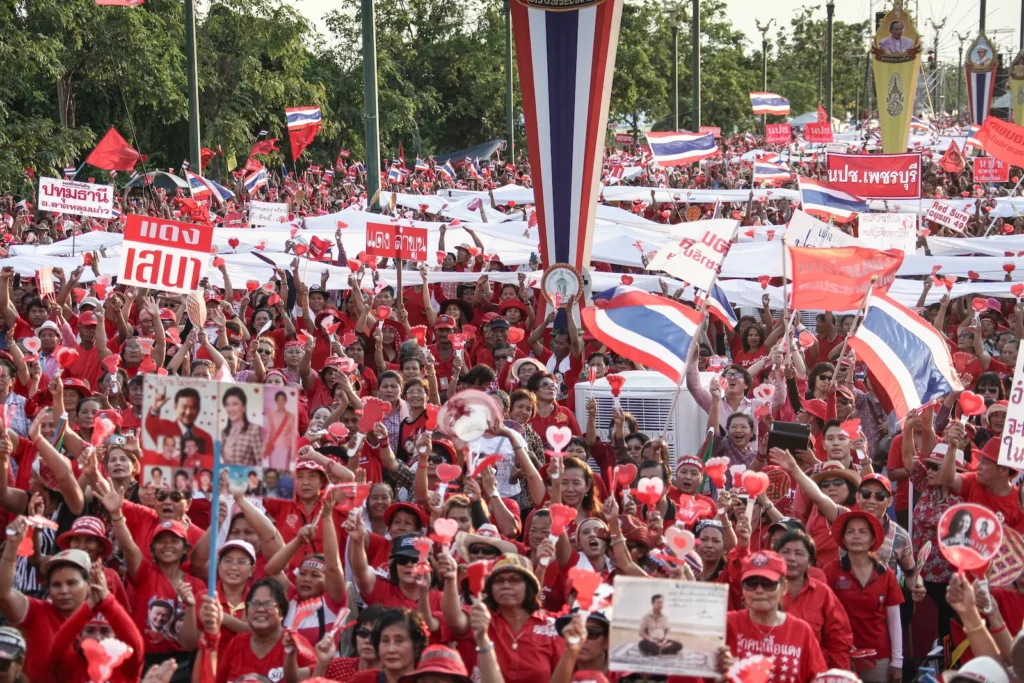
Wearing red head to toe, thousands of supporters of former Thai Prime Minister Yingluck Shinawatra attended a political rally in the western outskirts of Bangkok on May 10, 2014. Three days earlier, a Constitutional Court decision removed Thailand’s first female prime minister from office amid scrutiny over her roleYingluck Shinawatra – คำแถลง นางสาว ยิ่งลักษณ์ ชินวัตร, 2015 in a rice subsidy scheme under which her government bought the crop from farmers at prices above the world market rate.
The Shinawatra dynasty, a family of Chinese descent, built its political base among the rural working class and presided over several Thai governments in the first part of the 21st century. Casting itself as a champion of rural constituencies against Thailand’s conservative establishment, the family has faced repeated institutional challenges. Thaksin Shinawatra was ousted by a military coup in 2006, Yingluck Shinawatra saw her premiership cut short in 2014, and Paetongtarn Shinawatra was removed by the Constitutional Court in 2025.
Disproportionate escalation
Thai politicians have used rice subsidy policiesSingapore Management University – Politics and the price of rice in Thailand, 2018 for decades, first to win over voters among urban consumers and rice-sector businesses, before shifting toward farmers after the 1997 ConstitutionInternational Institute for Democracy and Electoral Assistance – Electoral system for national legislature, 1997 reformed the electoral system, elevating rural communities into a stronger political force. Rice farming households account for roughly a quarterBank of Ayudhya – Industry Outlook Rice Industry, 2024National Statistical Office – Statistical Yearbook Thailand, 2025 of all homes in Thailand. The schemes, however, did little to curb the use of fossil fuel–derived agricultural chemicals in rice fields, which cover about halfThailand Taxonomy Board – Agriculture sector, 2025 of the country’s total agricultural land.
High chemical inputs have contributed to productivity gains that reinforced the country’s status as the world’s second-largestWorld Integrated Trade Solution – Rice exports by country, 2024 rice exporter. Still, the 80%FAOSTAT – Crops and livestock products, 2024 increase in rice yield over the past six decades, to about three tonnes per hectare in 2024, belies a disproportionate escalation in fertiliser use, with application rates rising dozens of times.World Bank – Fertilizer consumption, 2023 The environmental consequences include the pollution of groundwater through agrochemical runoffGreenpeace – Use of agrochemicals in Thailand and its consequences for the environment, 2008 and biodiversity loss, notably the collapse of insect populationsReuters – The collapse of insects, 2022. In addition, the conversion of forests to farmland has been a primary driverGlobal Forest Watch – Thailand, 2024 of a 40% declineUnited Nations Forum on Forests – National Forest Financing Strategy of Thailand, 2019 in Thailand’s forest area since the early 1960s.
While agrochemical use continues to underpin rice exports at a significant environmental cost, political battles still rage on in Bangkok. In 2025, the Supreme Administrative Court ordered Yingluck Shinawatra to pay 10 billionBangkok Post – Former Thai PM Yingluck says she can't pay B10bn compensation, 2025 baht in damages for the rice subsidy scheme, down from an original 35 billion baht claim. Beyond the political wrangling over the Shinawatra family, Thai officials reversed a planned banReuters – Thailand’s chemical pesticide ban troubles farmers, 2020 on glyphosate in 2019, days before it was due to take effect, following lobbying by the U.S. government, and despite the International Agency for Research on Cancer classifying glyphosateReuters – International Agency for Research on Cancer, 2015 as “probably carcinogenic to humans.” Paradoxically, the rural base courted by Thai politicians faces the highest exposure to glyphosate, the second-most-usedInternational Journal of Environmental Science and Development – Pesticide Intensity in Rice Production in Central Thailand, 2025 herbicide in central Thailand’s rice fields.