
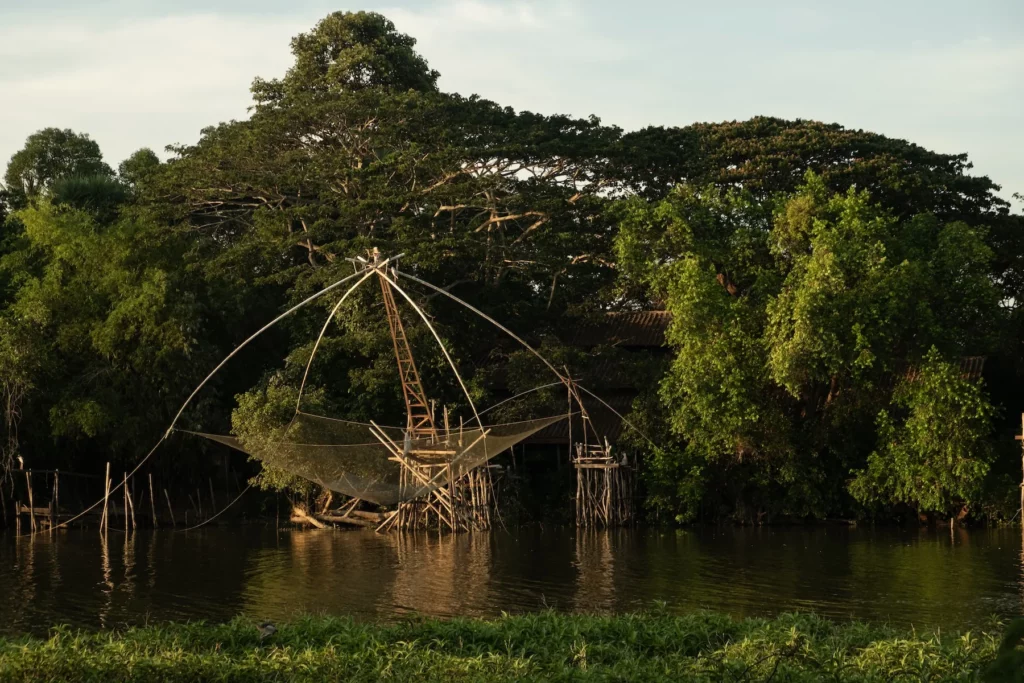
Stationary fishing nets, suspended from a wooden frame and periodically lifted to catch fish from the shallow waters in which they are submerged, have long dotted several riverbanks and seashores across parts of Asia. The fishing equipment, known as Cheena valaKerala Tourism – Chinese fishing nets in India, TangkulGarba Rujukan Digital – Diversity Of Tangkul Catches In Teluk Lake Olak Kemang Village Danau Teluk Distric Jambi City, 2024 in Indonesia, and SalambáwArchivo de la Universidad de Santo Tomas – Baybay, baybayin, Binondo, and the Parian, 2022 in the Philippines, has become a hallmark of Songkhla LakeProcedia, Social and Behavioral Sciences – Arsenic Cadmium and Lead Concentrations in Sediment and Biota from Songkhla Lake, 2013 in southern Thailand, where it is known as Yor YaksThe Nation – Unique way of life at upper Songkhla Lake under threat, 2018. The nets are calibrated to avoid the capture of non-target species and limit damage to aquatic habitats. Yet, only about 30Mongabay – What is happening to Thailand’s famous giant nets, 2026 reportedly remain in operation in Songkhla Lake, down from around 200, as water pollutionRangsit Journal of Arts and Sciences – Wastewater management skills of municipal human resources in Songkhla Lake Basin, 2014 affected fish populations.
Such traditional lift nets are thought to originate in ChinaKerala Tourism – Chinese fishing nets and are among the many fishing techniques developed over millennia. Humans incorporating seafood into their diet has been traced to over 160,000Science – Coastal Artifacts Suggest Early Beginnings for Modern Behavior, 2007 years ago, while earliest known evidence of long-distance ocean fishing dates back 42,000Reuters – Fishy find shows humans skilled anglers 42,000 years ago, 2012 years. The advent of fossil fuels-powered boats in the 19thMitsui O.S.K. Lines – History and transition of marine fuel, 2021 century marked a turning point in the history of fisheries, democratising the global industrial-scale harvesting of marine resources. Motorised fisheries have reduced the seafood supply chain dependence on coastal ecosystems by enabling fleets to exploit fish stocks farther offshore.
Dismissed as “antiquated”
Thailand was no exception. Fossil-fuel powered boats have criss-crossed the Gulf of Thailand for decades, contributing to rank the Southeast Asian country among the tenFood and Agriculture Organization – The State of World Fisheries and Aquaculture, 2026 largest exporters of fish and fishery products in the world. The economic gains, however, came at a long-term environmental cost as the Thai commercial fishing fleet, comprising about 11,000Food and Agriculture Organization – Thailand Department of Fisheries, 2026 vessels, “degraded fisheries resources”. By the mid-2010s, it took fishing boats in Thai waters seven timesEnvironmental Justice Foundation – Overfishing and pirate fishing perpetuate environmental degradation and modern-day slavery in Thailand, 2015 more effort to catch the same amount of fish as it did in the mid-1960s. Marine catches continued to decline, nearly halvingFood and Agriculture Organization – Thailand Fishery and Aquaculture Country Profile, 2025 over the three decades leading to the mid-2020s. Over the same period, the average length of Indo-Pacific mackerel, “fully exploited” in the Gulf of Thailand, dropped from 18 to 15Food and Agriculture Organization – Thailand Fishery and Aquaculture Country Profile, 2025 centimetres, a further sign of sustained overfishing. The country amendedBangkok Post – Slave labour threat revives, 2026 its Fisheries Law in 2025 to ease previous restrictions on environmentally destructive fishing methods.
While global fish consumption has become dependent on the exploitation of depleting far-flung fish populations, stationary fishing nets at Songkhla Lake remain closely tied to the integrity of the local ecosystem it is calibrated to. Communities living along shores of the coastal lagoon have “thrived in harmony” with the local ecosystem for centuries, maintaining an “intricate relationship” with the aquatic environmentJapan International Cooperation Agency – Fishes in Songkhla Lake, 1984, Thailand’s delegation to the United Nations Educational, Scientific and Cultural Organization notedUnited Nations Educational, Scientific and Cultural Organization – Songkhla and its Associated Lagoon Settlements, 2024. Yet, youth across Asia often viewContinental Shelf Research – Assessment of the stationary lift net fishery of East Hainan, Northern South China Sea, 2012 the ancestral lift nets as an “inefficient, labor-intensive or antiquated” fishing method.