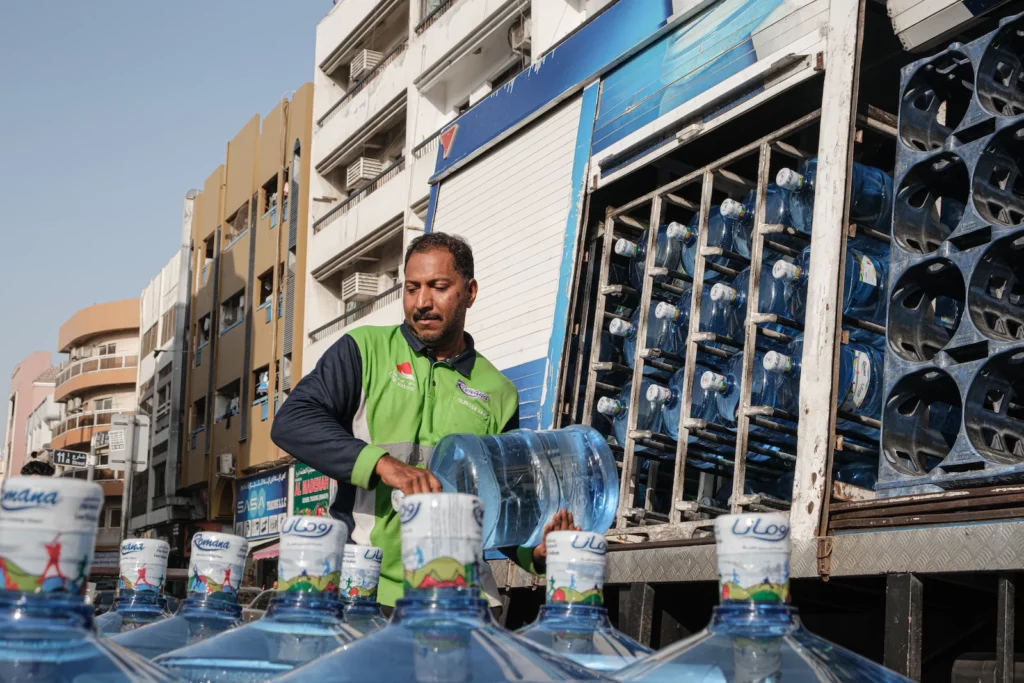
In the streets of Dubai’s historic commercial district,United Nations Educational, Scientific and Cultural Organization – Tentative Lists Khor Dubai, 2012 built along a seawater inlet of the Persian Gulf, a South Asian worker unloads a water delivery truck. The bottles contain one of the desert country’s scarcest resources. The United Arab Emirates lies in one of the most arid regionsNASA – Biome: Desert in the world, with no permanent rivers and one of the lowest levelsWorld Bank – Average precipitation in depth, 2022 of annual precipitation globally. Such an environment is not naturally suited to supporting large-scale human settlement. Yet the population of the West Asian country has increased more than thirty-foldUnited Nations Data Portal – Total population by sex United Arab Emirates, 2026 since its independence in 1971, and total freshwater consumption surged by nearly a quarterFederal Competitiveness and Statistics Centre – Quantity of Water Used by Emirate and Final User, 2022 during the 2010s alone.
On average, each person in the United Arab Emirates consumes 260 litresFederal Competitiveness and Statistics Centre – Quantity of Water Used by Emirate and Final User, 2022United Nations Data Portal – Total population by sex United Arab Emirates, 2026 of water at home per day. Water scarcity is barely noticeable in daily life as fossil fuel-powered desalination plants have enabled the country to shoot past population levels that its ecological capacities could otherwise sustain. A network of some 70 major desalination plantsUnited Arab Emirates Government – Water Security Strategy 2036 convert seawater into freshwater year-round, primarily for household use. Together, they meet 42% of total consumption across all sectors. Beyond desalination, the country taps into layers deep below the land surface to extract groundwater, mainly for agriculture, alongside reusing treated wastewater in industry.
Saltier than oceanic water
The dominant technologyUnited Arab Emirates Government – Water Security Strategy 2036Desalination and Water Treatment – Towards sustainable desalination industry in Arab region, 2020 at water plants in the United Arab Emirates is thermal desalination, a fossil fuel-intensive form of freshwater production. It primarily uses gas to heat saltwater until it evaporates, then condenses the resulting steamUnited Arab Emirates Government – Organization of American States into potable water. A transition is under way towards membrane-based technologies that require less energy,International Energy Agency – How electrification is transforming desalination, 2026 such as reverse osmosis, which relies on electricity-powered pumps to push saline water through a semipermeable material retaining salts and impurities. Yet, reverse osmosis plants in the United Arab Emirates remain major emitters of Earth-warming gases through the electricity they consume since over two-thirds of the country’s electricity was generated by burning gas as of 2023.
In Dubai’s historic commercial district, the bottles carried by the worker, which Romana Water Industries confirmed contain desalinated water, conceal the fragility of the local water system. Desalination plants also impact the marine environment as they release a by-product known as brine, often into the Persian Gulf. The concentrated wastewater contains various chemicalsDesalination – Brine management in desalination industry, 2019 and is up to twice as salineAdvanced Sustainable Systems – Total Resource Circulation of Desalination Brine, 2024 as normal oceanic water. The Emirati desalination industry produces roughly 10 million litresnpj Clean Water – Desalination and the Middle East, 2026 of brine per minute. West Asia’s water imbalance, masked on land to sustain large-scale settlement, has been externalised offshoreScientific Reports – Long-term, basin-scale salinity impacts from desalination in the Arabian/Persian Gulf, 2022 for decades in the form of discharged brine into the Persian Gulf.